2021 AP Calculus AB Free-Response Questions — Full Solutions
Complete worked solutions with scoring breakdowns for all 6 FRQs
Questions 1–2 (Part A, 30 min) permit a graphing calculator. Questions 3–6 (Part B, 60 min) do not.
Question 1
Calculator OKBacteria Density in a Petri Dish
Rate & Data from Tables
Open this question on its own pageValues of f(r)
| r (centimeters) | 0 | 1 | 2 | 2.5 | 4 |
|---|---|---|---|---|---|
| f(r) (mg per cm²) | 1 | 2 | 6 | 10 | 18 |
Answer
Full Solution & Work
Set up the difference quotient
Interpret the answer
AP Scoring — 2 Points
**P2**: Correct interpretation with units, tied to .
Answer
Full Solution & Work
Set up the right Riemann sum for the inner integral
Substitute values and compute
Multiply by 2π
AP Scoring — 3 Points
**P2**: Correctly computes the inner sum, 134.5.
**P3**: Correct final answer including the factor of : mg.
Answer
Full Solution & Work
Reason about the integrand
Apply the right-sum rule for increasing integrands
AP Scoring — 1 Point
Answer
Full Solution & Work
Set up the average value
Evaluate the average value
Solve g(k) = average value for k
AP Scoring — 3 Points
**P2**: Correctly evaluates the average value, .
**P3**: Correctly solves for within .
Study the concept
Learn the theory behind this question type with worked examples and strategy tips.
Question 2
Calculator OKTwo Particles Moving on the x-axis
Particle Motion
Open this question on its own pageAnswer
Full Solution & Work
Set up each position as initial position plus accumulated change
Evaluate with a calculator
AP Scoring — 2 Points
**P2**: Correct value, .
Answer
Full Solution & Work
Evaluate velocities at t = 1
Interpret using relative positions
Conclude
AP Scoring — 2 Points
**P2**: Correct conclusion ("toward each other"), tied to the relative positions of and .
Answer
Full Solution & Work
Differentiate v_Q(t) with the Product Rule
Evaluate at t = 1
Compare signs of v_Q and a_Q
AP Scoring — 2 Points
**P2**: Correct conclusion ("decreasing") tied to the opposite signs of and .
Answer
Full Solution & Work
Set up the total-distance integral
Note the sign change
Evaluate
AP Scoring — 3 Points
**P2**: Splits the integral correctly at the sign change (or uses a calculator's absolute-value integration directly).
**P3**: Correct final answer, 1.931.
Study the concept
Learn the theory behind this question type with worked examples and strategy tips.
Question 3
No CalculatorSpinning Toy — Volume of Revolution
Area & Volume
Open this question on its own pageAnswer
Full Solution & Work
Set up the area integral
Substitute u = 4 − x²
Evaluate
AP Scoring — 2 Points
**P2**: Correct answer, 16.
Answer
Full Solution & Work
Find where y is maximized
Find the maximum radius in terms of c
Solve for c
AP Scoring — 2 Points
**P2**: Correct answer, .
Answer
Full Solution & Work
Set up the volume of revolution
Evaluate the integral
Solve for c
AP Scoring — 3 Points
**P2**: Correctly evaluates .
**P3**: Correct final answer, .
Study the concept
Learn the theory behind this question type with worked examples and strategy tips.
Question 4
No CalculatorGraph Analysis with an Accumulation Function
Graph Analysis & Curve Sketching
Open this question on its own page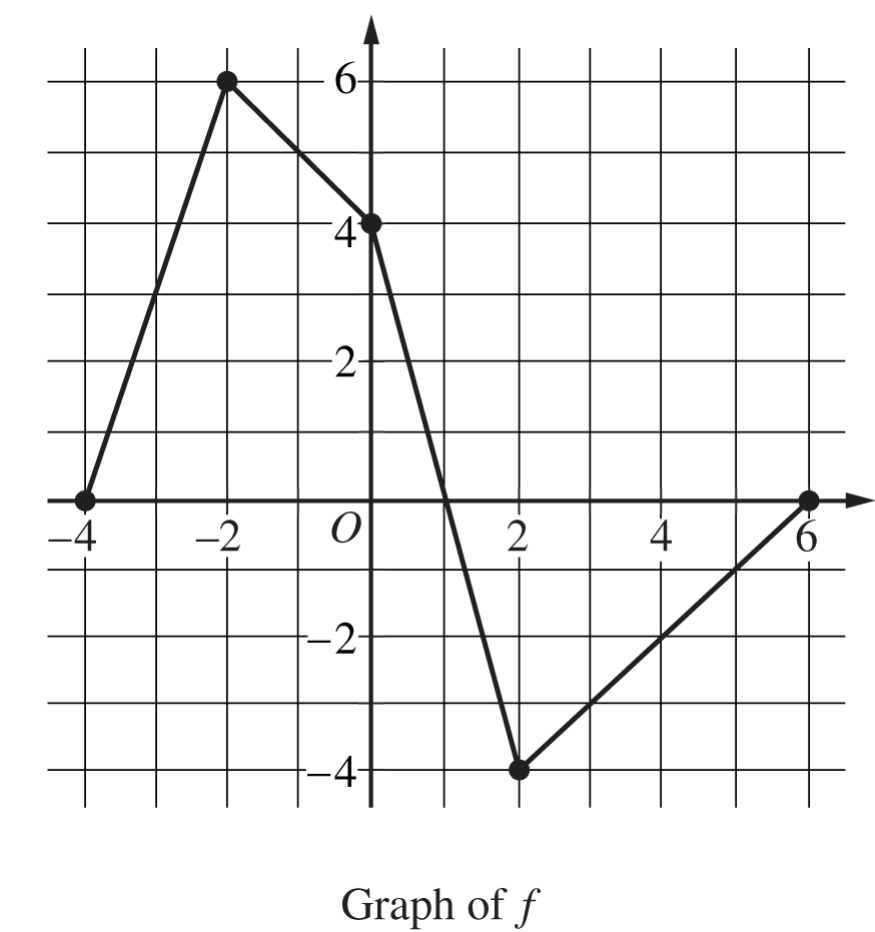
Answer
Full Solution & Work
Relate concavity of G to the slope of f
Compute each segment's slope
: slope .
: slope .
: slope .
Conclude
AP Scoring — 2 Points
**P2**: Correct intervals, and .
Answer
Full Solution & Work
Apply the Product Rule
Find f(3) and f'(3)
Find G(3)
Combine
AP Scoring — 3 Points
**P2**: Correctly finds , , and .
**P3**: Correct final answer, 1.375.
Answer
Full Solution & Work
Confirm the indeterminate form
Apply L'Hôpital's Rule
Evaluate
AP Scoring — 2 Points
**P2**: Correct final answer, .
Answer
Full Solution & Work
Find G(-4) and G(2)
Compute the average rate of change
Check the hypotheses of the MVT
Conclude
AP Scoring — 2 Points
**P2**: Correct "yes" with justification citing differentiability of (via continuity of ).
Study the concept
Learn the theory behind this question type with worked examples and strategy tips.
Question 5
No CalculatorImplicit Curve — Tangent Lines & Extrema
Implicit Differentiation
Open this question on its own pageAnswer
Full Solution & Work
Differentiate both sides implicitly
Solve for dy/dx
AP Scoring — 2 Points
**P2**: Requires P1. Correctly isolates to reach the given expression.
Answer
Full Solution & Work
Find the slope at (0, √3)
Write the tangent line
AP Scoring — 2 Points
**P2**: Correct tangent-line equation.
Answer
Full Solution & Work
Set dy/dx = 0
Solve for y at x = π/2
Since , .
State the point
AP Scoring — 2 Points
**P2**: Correctly solves the resulting quadratic for and selects the positive root, .
Answer
Full Solution & Work
Analyze the sign of dy/dx near x = π/2
Determine the sign change
Conclude
AP Scoring — 2 Points
**P2**: Correct conclusion, "relative maximum," tied to that sign change.
Study the concept
Learn the theory behind this question type with worked examples and strategy tips.
Question 6
No CalculatorMedication in the Bloodstream — Differential Equations
Differential Equations
Open this question on its own pageAnswer
Full Solution & Work
Determine the shape from the differential equation
AP Scoring — 1 Point
Answer
Full Solution & Work
State the interpretation
AP Scoring — 1 Point
Answer
Full Solution & Work
Separate variables
Integrate both sides
Apply the initial condition A(0) = 0
Since and increases toward 12, , so .
Solve for y
AP Scoring — 4 Points
**P2**: Correct antiderivatives on both sides.
**P3**: Correctly includes the constant of integration and applies the initial condition .
**P4**: Correct final answer, .
Answer
Full Solution & Work
Differentiate the differential equation with respect to t
Find B'(1) first
Evaluate the second derivative at t = 1
Conclude
AP Scoring — 3 Points
**P2**: Correctly sets up using the Quotient Rule (or equivalent) on the right side of the differential equation.
**P3**: Correct final value, , and correct conclusion ("decreasing").
Common mistake: This part is asking about the second derivative — whether the *rate itself* is speeding up or slowing down — not the sign of $B'(1)$ alone. Confusing "is $y$ increasing" with "is $\frac{dy}{dt}$ increasing" is the most common error on this type of question.
Study the concept
Learn the theory behind this question type with worked examples and strategy tips.

Gary Chang
Calculus Educator5+ Years of Calculus Teaching Experience | AP Calculus Specialist. Dedicated to helping students master calculus through step-by-step logic and clear visualizations.
Finished reviewing?