2023 AP Calculus AB Free-Response Questions — Full Solutions
Complete worked solutions with scoring breakdowns for all 6 FRQs
Questions 1–2 (Part A, 30 min) permit a graphing calculator. Questions 3–6 (Part B, 60 min) do not.
Question 1
Calculator OKGas Station Flow Rate — Table Data
Rate & Data from Tables
Open this question on its own pageValues of f(t)
| t (seconds) | 0 | 60 | 90 | 120 | 135 | 150 |
|---|---|---|---|---|---|---|
| f(t) (gallons per second) | 0 | 0.1 | 0.15 | 0.1 | 0.05 | 0 |
Answer
Full Solution & Work
Interpret the integral
Set up the right Riemann sum
Substitute and compute
AP Scoring — 3 Points
**P2**: At least five of the six numerical factors in the Riemann sum must be correct.
**P3**: The final answer 8.25 — an error anywhere in the Riemann sum forfeits this point.
Common mistake: A fully correct **left** Riemann sum with supporting work (e.g. $f(60)(30)+f(90)(30)+f(120)(15)=9$) earns 1 of the last 2 points — it demonstrates a valid Riemann-sum process but isn't the right sum the question asked for.
Answer
Full Solution & Work
Compute the average rate of change on [60,120]
Apply the Mean Value Theorem
AP Scoring — 2 Points
**P2**: Requires P1. The response must also state is continuous because is differentiable, and answer "yes." Citing the Intermediate Value Theorem here (instead of the Mean Value Theorem) does **not** earn this point.
Answer
Full Solution & Work
Set up the average value formula
Evaluate with a calculator
The average rate of flow of gasoline is **0.096** (or 0.095) gallons per second.
AP Scoring — 2 Points
**P2**: Correct answer 0.096 (or 0.095). Degree-mode calculators give the wrong value (0.150 or 0.003) and forfeit this point.
Answer
Full Solution & Work
Differentiate g and evaluate at t = 140
Interpret the meaning
AP Scoring — 2 Points
**P2**: The interpretation must include "the rate of flow of gasoline is changing at a rate of [the declared ]" and "at " — saying only "decreasing at a rate of " (a double-negative) does not earn this point.
Study the concept
Learn the theory behind this question type with worked examples and strategy tips.
Question 2
Calculator OKStephen's Swim — Particle Motion
Particle Motion
Open this question on its own pageAnswer
Full Solution & Work
Solve v(t) = 0 on (0, 90)
Interpret the sign change
AP Scoring — 2 Points
**P2**: The answer, , with reason — a response of just "" with no supporting work does not earn this point.
Answer
Full Solution & Work
Relate acceleration to v'(t)
Stephen's acceleration at seconds is meter per second per second.
Compare signs of v and a
AP Scoring — 3 Points
**P2**: A declared value for (units).
**P3**: Requires a presented value of correct to at least 1 decimal place, and consistent conclusion — "speeding up because and have the same sign" is sufficient without an explicit numeric .
Answer
Full Solution & Work
Set up the definite integral
Evaluate
The distance between Stephen's positions at and seconds is **23.384** (or 23.383) meters.
AP Scoring — 2 Points
**P2**: Only for the answer 23.384 (or 23.383), regardless of whether the first point was earned.
Answer
Full Solution & Work
Set up the total-distance integral
Evaluate
The total distance Stephen swims over seconds is **62.164** meters.
AP Scoring — 2 Points
**P2**: Only for the answer 62.164, regardless of whether the first point was earned.
Study the concept
Learn the theory behind this question type with worked examples and strategy tips.
Question 3
No CalculatorWarming Milk — Differential Equation
Differential Equations
Open this question on its own pageAnswer
Full Solution & Work
Follow the slope field from (0, 5)
AP Scoring — 1 Point
Answer
Full Solution & Work
Find the slope at t = 0
Apply the tangent-line approximation
The temperature of the milk at time minutes is approximately **22.5°C**.
AP Scoring — 2 Points
**P2**: An approximation using a tangent line through with slope (or a declared value of ), evaluated at . An unsupported approximation does not earn this point.
Answer
Full Solution & Work
Differentiate dM/dt with respect to t
Determine the sign and conclude
AP Scoring — 2 Points
**P2**: Requires stating (or " is decreasing" or " is concave down") **and** concluding "overestimate." An argument based on concavity at a single point does not earn this point.
Answer
Full Solution & Work
Separate variables
Integrate both sides
Apply the initial condition
Because for all , , so .
Solve for M
AP Scoring — 4 Points
**P2**: Finds antiderivatives on both sides (presenting without absolute value symbols is still eligible for all 4 points).
**P3**: Correctly includes the constant of integration and uses the initial condition. Requires the first 2 points.
**P4**: Earned only for the final answer (or equivalent) — requires the first 3 points.
Study the concept
Learn the theory behind this question type with worked examples and strategy tips.
Question 4
No CalculatorAnalyzing a Function from its Derivative Graph
Graph Analysis & Curve Sketching
Open this question on its own page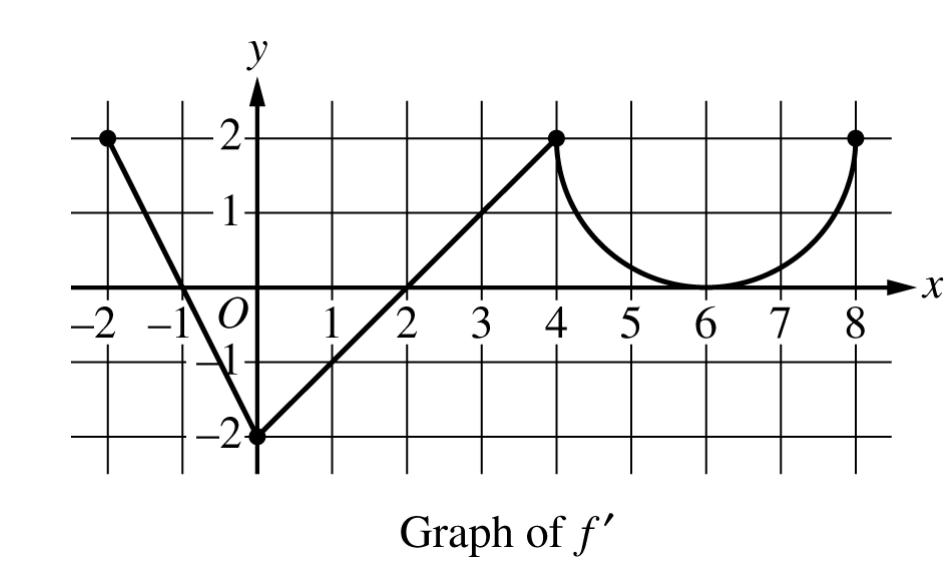
Answer
Full Solution & Work
Check the sign of f' around x = 6
Conclude
AP Scoring — 1 Point
Answer
Full Solution & Work
Relate concavity of f to the behavior of f'
Read decreasing intervals off the graph of f'
AP Scoring — 2 Points
**P2**: Requires P1. Must correctly discuss the behavior of (or the slopes of ) as the reason.
Common mistake: A response with exactly one of the two correct intervals, with a correct reason, still earns 1 of the 2 points as a special case.
Answer
Full Solution & Work
Confirm the indeterminate form
The limit is of indeterminate form , so L'Hôpital's Rule can be applied.
Apply L'Hôpital's Rule
Read f'(2) off the graph and finish
AP Scoring — 3 Points
**P2**: Applying L'Hôpital's Rule — presenting at least one correct derivative in the limit of a ratio of derivatives.
**P3**: The correct answer, 3, with supporting work.
Answer
Full Solution & Work
Find critical points
Evaluate f at critical points and endpoints
(these are found by adding/subtracting the signed areas between consecutive -values, using as the anchor value)
Conclude
AP Scoring — 3 Points
**P2**: A justification: is continuous on and correctly evaluated at all 5 candidates. Any error in evaluating at a candidate point forfeits this point. (A response need not evaluate if it argues is a local max via other reasoning, and need not evaluate if it argues for , hence .)
**P3**: Earned only for indicating the minimum value is 1 — noting only that the minimum *occurs at* is not sufficient.
Study the concept
Learn the theory behind this question type with worked examples and strategy tips.
Question 5
No CalculatorTabular Data, Chain Rule & FTC
Limits, Chain Rule & FTC
Open this question on its own pageValues of f, f', g, and g'
| x | 0 | 2 | 4 | 7 |
|---|---|---|---|---|
| f(x) | 10 | 7 | 4 | 5 |
| f′(x) | 3/2 | −8 | 3 | 6 |
| g(x) | 1 | 2 | −3 | 0 |
| g′(x) | 5 | 4 | 2 | 8 |
Answer
Full Solution & Work
Apply the Chain Rule
Evaluate at x = 7
AP Scoring — 2 Points
**P2**: Requires P1 — only for the answer 12 (if P1 is not earned, this point can still be earned only for the response or ).
Answer
Full Solution & Work
Differentiate k'(x) using Product and Chain Rules
Evaluate at x = 4
Conclude
AP Scoring — 3 Points
**P2**: Requires correctly computing with supporting work.
**P3**: A correct answer and reason consistent with the declared value of .
Answer
Full Solution & Work
Apply the Fundamental Theorem of Calculus
AP Scoring — 1 Point
Answer
Full Solution & Work
Differentiate m(x)
Evaluate at x = 2
Conclude
AP Scoring — 3 Points
**P2**: Correctly evaluates , , or — an unsupported response of alone does not earn this point.
**P3**: An answer and justification consistent with the declared value of .
Study the concept
Learn the theory behind this question type with worked examples and strategy tips.
Question 6
No CalculatorImplicit Curve — Tangent Lines & Related Rates
Implicit Differentiation
Open this question on its own pageAnswer
Full Solution & Work
Differentiate both sides implicitly
Solve for dy/dx
AP Scoring — 2 Points
**P2**: Requires P1. It is sufficient to present , provided there are no subsequent errors.
Answer
Full Solution & Work
Set dy/dx = 0
Test y = 0 in the original curve equation
Conclude
AP Scoring — 2 Points
**P2**: The answer with reason — a response does not need to also state that at that point.
Answer
Full Solution & Work
Set the denominator equal to 0
Substitute into the curve equation
Find x
The tangent line to the curve is vertical at the point .
AP Scoring — 3 Points
**P2**: Substituting (or from ) into the original curve equation.
**P3**: Both coordinates of the point , labeled — a response that identifies the point without verifying it satisfies the curve equation does not earn P2 or P3.
Answer
Full Solution & Work
Differentiate 6xy = 2+y³ implicitly with respect to t
Substitute the known values
Solve for dy/dt
AP Scoring — 2 Points
**P2**: The correct answer — an unsupported response of alone earns no points.
Common mistake: Alternate route: use $\frac{dy}{dx}\big|_{(1/2,-2)}=\frac{2(-2)}{(-2)^2-2(1/2)}=-\frac43$ from part (a)'s formula, then $\frac{dy}{dt}=\frac{dy}{dx}\cdot\frac{dx}{dt}=-\frac43\cdot\frac23=-\frac89$.
Study the concept
Learn the theory behind this question type with worked examples and strategy tips.

Gary Chang
Calculus Educator5+ Years of Calculus Teaching Experience | AP Calculus Specialist. Dedicated to helping students master calculus through step-by-step logic and clear visualizations.
Finished reviewing?