← All Exam Answers

2024 AP Calculus AB Free-Response Questions — Full Solutions

Complete worked solutions with scoring breakdowns for all 6 FRQs

6 Questions21 Parts TotalFull Solutions Included

Questions 1–2 (Part A, 30 min) permit a graphing calculator. Questions 3–6 (Part B, 60 min) do not.

Question 1

Calculator OK

Coffee Temperature — Table Data

Rate & Data from Tables

Open this question on its own page
Hard
The temperature of coffee in a cup at time tt minutes is modeled by a decreasing differentiable function CC, where C(t)C(t) is measured in degrees Celsius. For 0≤t≤120 \leq t \leq 12, selected values of C(t)C(t) are given in the table shown.

Values of C(t)

t (minutes)03712
C(t) (degrees Celsius)100856955
Part AEasy2 points
Approximate C′(5)C'(5) using the average rate of change of CC over the interval 3≤t≤73 \leq t \leq 7. Show the work that leads to your answer and include units of measure.

Answer

C′(5)≈C(7)−C(3)7−3=69−854=−4C'(5) \approx \dfrac{C(7)-C(3)}{7-3} = \dfrac{69-85}{4} = -4 degrees Celsius per minute
Full Solution & Work

Set up the difference quotient

C′(5)≈C(7)−C(3)7−3=69−854=−164=−4C'(5) \approx \frac{C(7)-C(3)}{7-3} = \frac{69-85}{4} = \frac{-16}{4} = -4

State the units

The units are degrees Celsius per minute.

AP Scoring — 2 Points

**P1**: A response must include a difference and a quotient as supporting work — −164\frac{-16}{4}, 69−854\frac{69-85}{4}, or equivalent is sufficient.
**P2**: Units of "degrees Celsius per minute" attached to a numerical value. Units alone with no numerical approximation do not earn this point.
Part BMedium3 points
Use a left Riemann sum with the three subintervals indicated by the data in the table to approximate the value of ∫012C(t) dt\int_0^{12} C(t)\,dt. Interpret the meaning of 112∫012C(t) dt\dfrac{1}{12}\int_0^{12} C(t)\,dt in the context of the problem.

Answer

∫012C(t) dt≈3⋅C(0)+4⋅C(3)+5⋅C(7)=300+340+345=985\int_0^{12} C(t)\,dt \approx 3\cdot C(0) + 4\cdot C(3) + 5\cdot C(7) = 300+340+345=985
Full Solution & Work

Set up the left Riemann sum

∫012C(t) dt≈(3−0)⋅C(0)+(7−3)⋅C(3)+(12−7)⋅C(7)\int_0^{12} C(t)\,dt \approx (3-0)\cdot C(0) + (7-3)\cdot C(3) + (12-7)\cdot C(7)

Substitute values and compute

=3⋅100+4⋅85+5⋅69=300+340+345=985= 3\cdot 100 + 4\cdot 85 + 5\cdot 69 = 300+340+345=985

Interpret the average value expression

112∫012C(t) dt\dfrac{1}{12}\int_0^{12} C(t)\,dt is the **average temperature of the coffee** (in degrees Celsius) **over the time interval from t=0t=0 to t=12t=12**.

AP Scoring — 3 Points

**P1**: Correct form of the left Riemann sum — at least five of the six numerical factors must be correct.
**P2**: Correct estimate, 985 — requires P1 (a fully correct right Riemann sum, e.g.
4⋅85+4⋅69+5⋅554\cdot 85+4\cdot 69+5\cdot 55, earns P1 but not P2).
**P3**: Interpretation must include both "average temperature" and the time interval; units are not required, but incorrect units forfeit this point.
Part CMedium3 points
For 12≤t≤2012 \leq t \leq 20, the rate of change of the temperature of the coffee is modeled by C′(t)=−24.55e0.01ttC'(t) = \dfrac{-24.55e^{0.01t}}{t}, where C′(t)C'(t) is measured in degrees Celsius per minute. Find the temperature of the coffee at time t=20t=20. Show the setup for your calculations.

Answer

C(20)=C(12)+∫1220C′(t) dt=55−14.670812=40.329C(20) = C(12) + \displaystyle\int_{12}^{20} C'(t)\,dt = 55-14.670812=40.329
Full Solution & Work

Set up C(20) using C(12) plus accumulated change

C(20)=C(12)+∫1220C′(t) dtC(20) = C(12) + \int_{12}^{20} C'(t)\,dt

Substitute the known value and evaluate

=55+∫1220−24.55e0.01tt dt=55−14.670812=40.329188= 55 + \int_{12}^{20} \frac{-24.55e^{0.01t}}{t}\,dt = 55 - 14.670812 = 40.329188

State the answer

The temperature of the coffee at time t=20t=20 is **40.329** degrees Celsius.

AP Scoring — 3 Points

**P1**: A definite integral with integrand C′(t)C'(t). If the limits of integration are incorrect, this response is not eligible for the third point.
**P2**: Adding
C(12)C(12) (or 55) to a definite integral with lower limit 12.
**P3**: Correct answer
55−14.67155-14.671 (with supporting work) — an answer of just 40.329 with no supporting work earns no points at all.

Common mistake: A "linkage error" like writing $C(20)=\int_{12}^{20}C'(t)\,dt = 55-14.670812$ (treating the whole right side as equal to the integral alone) still earns the first two points but not the third — keep the equation chain unambiguous.

Part DMedium1 point
For the model defined in part (c), it can be shown that C′′(t)=0.2455e0.01t(100−t)t2C''(t) = \dfrac{0.2455e^{0.01t}(100-t)}{t^2}. For 12<t<2012 < t < 20, determine whether the temperature of the coffee is changing at a decreasing rate or at an increasing rate. Give a reason for your answer.

Answer

Increasing rate, because C′′(t)>0C''(t) > 0 on 12<t<2012 < t < 20.
Full Solution & Work

Determine the sign of C''(t)

For 12<t<2012<t<20: 0.01t<10.01t < 1 so e0.01t>0e^{0.01t}>0; 100−t>0100-t>0 (since t<20<100t<20<100); t2>0t^2>0. So C′′(t)>0C''(t)>0 throughout this interval.

Interpret the sign

Because C′′(t)>0C''(t)>0 on 12<t<2012<t<20, the rate of change C′(t)C'(t) is **increasing** on this interval — that is, the temperature is changing at an **increasing rate**.

AP Scoring — 1 Point

**P1**: Earned only for a correct answer with a correct reason that references the sign of the **second derivative** of CC. A reason based on evaluating C′′(t)C''(t) at only a single point does not earn this point, and neither does an ambiguous pronoun like "it is positive, so increasing."

Study the concept

Learn the theory behind this question type with worked examples and strategy tips.

Practice More

Question 2

Calculator OK

Particle Velocity — Logarithmic Model

Particle Motion

Open this question on its own page
Hard
A particle moves along the xx-axis so that its velocity at time t≥0t \geq 0 is given by v(t)=ln⁡(t2−4t+5)−0.2tv(t) = \ln(t^2-4t+5) - 0.2t.
Part AEasy2 points
There is one time, t=tRt=t_R, in the interval 0<t<20<t<2 when the particle is at rest (not moving). Find tRt_R. For 0<t<tR0<t<t_R, is the particle moving to the right or to the left? Give a reason for your answer.

Answer

tR=1.426t_R = 1.426 (or 1.4251.425); moving right for 0<t<tR0<t<t_R.
Full Solution & Work

Solve v(t) = 0 on (0,2)

v(t)=0  ⟹  t=1.425610v(t) = 0 \implies t = 1.425610

So
tR=1.426t_R = 1.426 (or 1.425).

Determine direction on (0, t_R)

For 0<t<tR0<t<t_R, v(t)>0v(t)>0. Therefore, the particle is moving to the **right** on that interval.

AP Scoring — 2 Points

**P1**: The value tR=1.426t_R=1.426 (or 1.425) — a response that finds no value or an incorrect value of tRt_R is not eligible for the second point.
**P2**: Correct direction (right) with the explanation that
v(t)>0v(t)>0 on (0,tR)(0,t_R).
Part BMedium2 points
Find the acceleration of the particle at time t=1.5t=1.5. Show the setup for your calculations. Is the speed of the particle increasing or decreasing at time t=1.5t=1.5? Explain your reasoning.

Answer

a(1.5)=v′(1.5)=−1a(1.5)=v'(1.5)=-1; speed is increasing at t=1.5t=1.5.
Full Solution & Work

Relate acceleration to v'(t)

a(1.5)=v′(1.5)=−1 (or −0.999)a(1.5) = v'(1.5) = -1 \text{ (or } -0.999\text{)}

Compare signs of v and a

v(1.5)=−0.076856<0v(1.5) = -0.076856 < 0. Because a(1.5)a(1.5) and v(1.5)v(1.5) have the **same sign** (both negative), the speed of the particle is **increasing** at t=1.5t=1.5.

AP Scoring — 2 Points

**P1**: A response must demonstrate the relationship v′=av'=a to earn this point — just stating "a(1.5)=−1a(1.5)=-1" with no connection to v′v' is not sufficient.
**P2**: Earned only for a response consistent with a negative velocity at
t=1.5t=1.5 and the presented value of a(1.5)a(1.5).
Part CMedium3 points
The position of the particle at time tt is x(t)x(t), and its position at time t=1t=1 is x(1)=−3x(1)=-3. Find the position of the particle at time t=4t=4. Show the setup for your calculations.

Answer

x(4)=x(1)+∫14v(t) dt=−3+0.197117=−2.803x(4) = x(1) + \displaystyle\int_1^4 v(t)\,dt = -3+0.197117=-2.803
Full Solution & Work

Set up x(4) using x(1) plus accumulated change

x(4)=x(1)+∫14v(t) dtx(4) = x(1) + \int_1^4 v(t)\,dt

Evaluate

=−3+0.197117=−2.802883= -3+0.197117 = -2.802883

The position of the particle at time
t=4t=4 is **−2.803-2.803** (or −2.802-2.802).

AP Scoring — 3 Points

**P1**: A definite integral with integrand v(t)v(t). If the limits of integration are incorrect, this response is not eligible for the third point.
**P2**: Adding
x(1)x(1) (or −3-3) to a definite integral with lower limit 1.
**P3**: Correct answer
−3+0.197-3+0.197 with supporting work — an answer of just −2.803-2.803 with no supporting work earns no points.
Part DMedium2 points
Find the total distance traveled by the particle over the interval 1≤t≤41 \leq t \leq 4. Show the setup for your calculations.

Answer

∫14∣v(t)∣ dt=0.958\displaystyle\int_1^4 |v(t)|\,dt = 0.958
Full Solution & Work

Set up the distance integral

Distance=∫14∣v(t)∣ dt\text{Distance} = \int_1^4 |v(t)|\,dt

Evaluate with a calculator

=0.9581= 0.9581

The total distance traveled by the particle over
1≤t≤41 \leq t \leq 4 is **0.958**.

AP Scoring — 2 Points

**P1**: The integral ∫14∣v(t)∣ dt\int_1^4 |v(t)|\,dt, or an equivalent split at the sign changes of vv (at t≈1.425t\approx1.425 and t≈2.883t\approx2.883, the other root of v(t)=0v(t)=0).
**P2**: Due to variations in numerical integration across calculator models, answers of 0.958, 0.959, or 0.96 all earn this point.

Study the concept

Learn the theory behind this question type with worked examples and strategy tips.

Practice More

Question 3

No Calculator

Seawater Depth — Differential Equation

Differential Equations

Open this question on its own page
Hard
The depth of seawater at a location can be modeled by the function HH that satisfies the differential equation dHdt=12(H−1)cos⁡ ⁣(t2)\dfrac{dH}{dt} = \dfrac{1}{2}(H-1)\cos\!\left(\dfrac{t}{2}\right), where H(t)H(t) is measured in feet and tt is measured in hours after noon (t=0t=0). It is known that H(0)=4H(0)=4.
Part AEasy1 point
A portion of the slope field for the differential equation is provided. Sketch the solution curve, y=H(t)y=H(t), through the point (0,4)(0,4).

Answer

The curve passes through (0,4)(0,4), rises to a local max around t=πt=\pi, then decreases.
Full Solution & Work

Follow the slope field from (0, 4)

Starting at (0,4)(0,4), follow the slope-field arrows: since H>1H>1 and cos⁡(t/2)>0\cos(t/2)>0 for small t>0t>0, dHdt>0\frac{dH}{dt}>0 initially, so the curve rises. Slopes flatten and turn negative once tt passes π\pi (where cos⁡(t/2)=0\cos(t/2)=0), so the curve peaks near t=πt=\pi and then decreases through the rest of the shown domain (matches the official figure, which peaks around H≈9H\approx 9 near t≈3t\approx 3).

AP Scoring — 1 Point

**P1**: The solution curve must pass through (0,4)(0,4), extend to at least t=4.5t=4.5, and have no obvious conflicts with the given slope lines.
Part BHard3 points
For 0<t<50<t<5, it can be shown that H(t)>1H(t)>1. Find the value of tt, for 0<t<50<t<5, at which HH has a critical point. Determine whether the critical point corresponds to a relative minimum, a relative maximum, or neither a relative minimum nor a relative maximum of the depth of seawater at the location. Justify your answer.

Answer

t=πt=\pi is a relative maximum.
Full Solution & Work

Set dH/dt = 0

Because H(t)>1H(t)>1, dHdt=0\frac{dH}{dt}=0 implies cos⁡ ⁣(t2)=0\cos\!\left(\frac{t}{2}\right)=0, which gives t=πt=\pi as a critical point in 0<t<50<t<5.

Sign-analyze dH/dt around t = π

For 0<t<π0<t<\pi: dHdt>0\frac{dH}{dt}>0. For π<t<5\pi<t<5: dHdt<0\frac{dH}{dt}<0. Therefore, t=πt=\pi is the location of a **relative maximum** value of HH.

AP Scoring — 3 Points

**P1**: Considers dHdt=0\frac{dH}{dt}=0, dHdt>0\frac{dH}{dt}>0, dHdt<0\frac{dH}{dt}<0, cos⁡(t/2)=0\cos(t/2)=0, or cos⁡(t/2)>0\cos(t/2)>0/<0<0.
**P2**: Identifies
t=πt=\pi, with or without supporting work.
**P3**: Cannot be earned without P1. Earned only for a correct justification and the correct answer "relative maximum." The justification can be a sign analysis of
dHdt\frac{dH}{dt} on either side of π\pi, or a Second Derivative Test showing d2Hdt2∣t=π<0\frac{d^2H}{dt^2}\big|_{t=\pi}<0.
Part CHard5 points
Use separation of variables to find y=H(t)y=H(t), the particular solution to the differential equation dHdt=12(H−1)cos⁡ ⁣(t2)\dfrac{dH}{dt}=\dfrac{1}{2}(H-1)\cos\!\left(\dfrac{t}{2}\right) with initial condition H(0)=4H(0)=4.

Answer

H(t)=1+3esin⁡(t/2)H(t) = 1+3e^{\sin(t/2)}
Full Solution & Work

Separate variables

dHH−1=12cos⁡ ⁣(t2)dt\frac{dH}{H-1} = \frac{1}{2}\cos\!\left(\frac{t}{2}\right)dt

Integrate both sides

∫dHH−1=∫12cos⁡ ⁣(t2)dt\int \frac{dH}{H-1} = \int \frac{1}{2}\cos\!\left(\frac{t}{2}\right)dt

ln⁡∣H−1∣=sin⁡ ⁣(t2)+C\ln|H-1| = \sin\!\left(\frac{t}{2}\right)+C

Apply the initial condition

ln⁡∣4−1∣=sin⁡(0)+C  ⟹  C=ln⁡3\ln|4-1| = \sin(0)+C \implies C=\ln 3

Because
H(0)=4H(0)=4, H>1H>1, so ∣H−1∣=H−1|H-1|=H-1.
ln⁡(H−1)=sin⁡ ⁣(t2)+ln⁡3\ln(H-1) = \sin\!\left(\frac{t}{2}\right)+\ln 3

Solve for H

H−1=esin⁡(t/2)+ln⁡3=3esin⁡(t/2)H-1 = e^{\sin(t/2)+\ln 3} = 3e^{\sin(t/2)}

H(t)=1+3esin⁡(t/2)H(t) = 1+3e^{\sin(t/2)}

AP Scoring — 5 Points

**P1**: Correct separation of variables — a response with no separation of variables earns 0 of 5 points.
**P2**: One correct antiderivative (either side).
**P3**: Both correct antiderivatives — presenting
ln⁡(H−1)\ln(H-1) without absolute value symbols still earns this point.
**P4**: Correctly includes the constant of integration and uses the initial condition
H(0)=4H(0)=4. Requires P1 and at least one of P2/P3.
**P5**: Earned only for the final answer
H(t)=1+3esin⁡(t/2)H(t)=1+3e^{\sin(t/2)} (or an equivalent form) — requires all 4 previous points.

Study the concept

Learn the theory behind this question type with worked examples and strategy tips.

Practice More

Question 4

No Calculator

Region R and Its Accumulation Function

Graph Analysis & Curve Sketching

Open this question on its own page
Hard
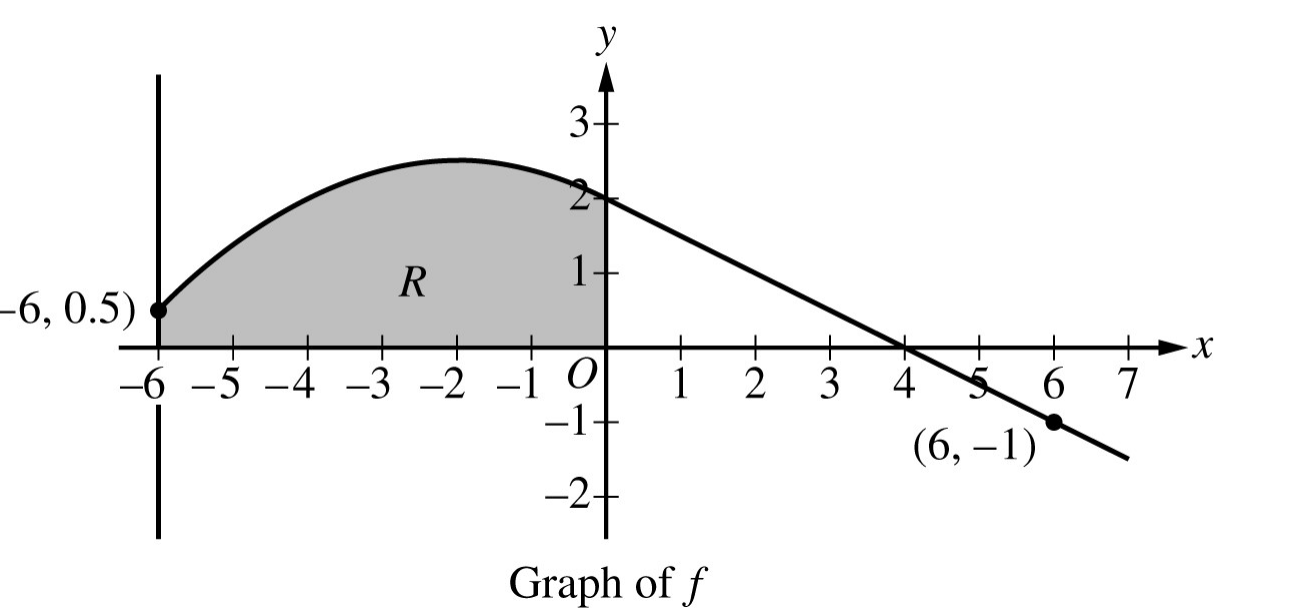
The graph of the differentiable function ff, shown for −6≤x≤7-6 \leq x \leq 7, has a horizontal tangent at x=−2x=-2 and is linear for 0≤x≤70 \leq x \leq 7. Let RR be the region in the second quadrant bounded by the graph of ff, the vertical line x=−6x=-6, and the xx- and yy-axes. Region RR has area 12.
2024 AP Calculus AB FRQ Question 4 Graph of f, with shaded region R
Graph of $f$, with region $R$ (area 12) shaded.
Part AMedium3 points
The function gg is defined by g(x)=∫0xf(t) dtg(x)=\int_0^x f(t)\,dt. Find the values of g(−6)g(-6), g(4)g(4), and g(6)g(6).

Answer

g(−6)=−12g(-6)=-12, g(4)=4g(4)=4, g(6)=3g(6)=3
Full Solution & Work

Find g(-6) using region R's given area

g(−6)=∫0−6f(t) dt=−∫−60f(t) dt=−12g(-6) = \int_0^{-6} f(t)\,dt = -\int_{-6}^0 f(t)\,dt = -12

(since
∫−60f(t) dt\int_{-6}^0 f(t)\,dt is exactly the area of RR, given as 12)

Find g(4) as a triangle area

ff is linear on [0,7][0,7], passing through (0,2)(0,2) and (4,2)(4,2)... reading the graph, the line from (0,2)(0,2) crosses the xx-axis at x=4x=4:
g(4)=∫04f(t) dt=12⋅4⋅2=4g(4)=\int_0^4 f(t)\,dt = \frac{1}{2}\cdot 4\cdot 2 = 4

Find g(6) as a signed sum of triangle areas

g(6)=∫06f(t) dt=12⋅4⋅2−12⋅2⋅1=4−1=3g(6) = \int_0^6 f(t)\,dt = \frac{1}{2}\cdot 4\cdot 2 - \frac{1}{2}\cdot 2\cdot 1 = 4-1=3

AP Scoring — 3 Points

**P1**: g(−6)=−12g(-6)=-12.
**P2**:
g(4)=4g(4)=4.
**P3**:
g(6)=3g(6)=3.
Supporting work is not required for any of these, but any shown work must be correct to earn the point. Unlabeled values are read left-to-right / top-to-bottom as
g(−6),g(4),g(6)g(-6), g(4), g(6) — a response presenting only 1 or 2 values must label them to earn credit.
Part BMedium2 points
For the function gg defined in part (a), find all values of xx in the interval 0≤x≤60 \leq x \leq 6 at which the graph of gg has a critical point. Give a reason for your answer.

Answer

x=4x=4
Full Solution & Work

Apply the Fundamental Theorem of Calculus

g′(x)=f(x)g'(x) = f(x)

Solve g'(x) = 0

g′(x)=f(x)=0  ⟹  x=4g'(x)=f(x)=0 \implies x=4

Therefore, the graph of
gg has a critical point at x=4x=4.

AP Scoring — 2 Points

**P1**: Explicitly making the connection g′=fg'=f in this part.
**P2**: Correct answer
x=4x=4 with reason — a response reporting any additional critical points in 0<x<60<x<6 does not earn this point.
Part CHard4 points
The function hh is defined by h(x)=∫−6xf′(t) dth(x)=\int_{-6}^x f'(t)\,dt. Find the values of h(6)h(6), h′(6)h'(6), and h′′(6)h''(6). Show the work that leads to your answers.

Answer

h(6)=−1.5h(6)=-1.5, h′(6)=−12h'(6)=-\frac{1}{2}, h′′(6)=0h''(6)=0
Full Solution & Work

Find h(6) using the Fundamental Theorem of Calculus

h(6)=∫−66f′(t) dt=f(6)−f(−6)=−1−0.5=−1.5h(6) = \int_{-6}^6 f'(t)\,dt = f(6)-f(-6) = -1-0.5=-1.5

Find h'(6)

h′(x)=f′(x)  ⟹  h′(6)=f′(6)=−12h'(x)=f'(x) \implies h'(6)=f'(6)=-\frac{1}{2}

(the slope of the linear piece of
ff on [0,7][0,7], found from the two labeled points (4,2)→(6,−1)(4,2)\to(6,-1)-consistent slope −12-\frac{1}{2})

Find h''(6)

h′′(x)=f′′(x)  ⟹  h′′(6)=f′′(6)=0h''(x)=f''(x) \implies h''(6)=f''(6)=0

(since
ff is linear on [0,7][0,7], its second derivative is identically 0 there)

AP Scoring — 4 Points

**P1**: Uses the Fundamental Theorem of Calculus for h(6)h(6).
**P2**:
h(6)=−1.5h(6)=-1.5 with supporting work — a bare answer of h(6)=−1.5h(6)=-1.5 does not earn either of the first two points; h(6)=f(6)−f(−6)h(6)=f(6)-f(-6) earns only the first.
**P3**: States either
h′(x)=f′(x)h'(x)=f'(x) or h′(6)=f′(6)h'(6)=f'(6), and provides the answer −12-\frac{1}{2}.
**P4**:
h′′(6)=0h''(6)=0, with or without supporting work.

Common mistake: Any response that has one or more linkage errors does not earn the point it would have otherwise earned for that step, but stays eligible for subsequent points if those are handled correctly.

Study the concept

Learn the theory behind this question type with worked examples and strategy tips.

Practice More

Question 5

No Calculator

Implicit Curve — Tangent Lines & Related Rates

Implicit Differentiation

Open this question on its own page
Hard
Consider the curve defined by the equation x2+3y+2y2=48x^2+3y+2y^2=48. It can be shown that dydx=−2x3+4y\dfrac{dy}{dx}=\dfrac{-2x}{3+4y}.
Part AMedium2 points
There is a point on the curve near (2,4)(2,4) with xx-coordinate 3. Use the line tangent to the curve at (2,4)(2,4) to approximate the yy-coordinate of this point.

Answer

y≈4−419(3−2)=7219y \approx 4-\dfrac{4}{19}(3-2)=\dfrac{72}{19}
Full Solution & Work

Find the slope at (2,4)

dydx∣(2,4)=−2(2)3+4(4)=−419\left.\frac{dy}{dx}\right|_{(2,4)} = \frac{-2(2)}{3+4(4)} = \frac{-4}{19}

Apply the tangent line approximation

y≈4−419(3−2)=7219y \approx 4-\frac{4}{19}(3-2) = \frac{72}{19}

AP Scoring — 2 Points

**P1**: Correctly finding dydx∣(2,4)=−419\left.\frac{dy}{dx}\right|_{(2,4)}=-\frac{4}{19}, even if not labeled or used as a tangent-line slope.
**P2**: Correct approximation, evaluated at
x=3x=3 using a linear approximation through (2,4)(2,4) with slope −419-\frac{4}{19}.
Part BHard2 points
Is the horizontal line y=1y=1 tangent to the curve? Give a reason for your answer.

Answer

No — the only candidate point of tangency, (0,1)(0,1), is not on the curve.
Full Solution & Work

Find where dy/dx = 0

dydx=−2x3+4y=0  ⟹  x=0\frac{dy}{dx} = \frac{-2x}{3+4y}=0 \implies x=0

So if
y=1y=1 is tangent to the curve, the point of tangency must be (0,1)(0,1).

Check whether (0,1) lies on the curve

02+3(1)+2(1)2=5≠480^2+3(1)+2(1)^2 = 5 \neq 48

The point
(0,1)(0,1) is not on the curve. Therefore, the horizontal line y=1y=1 is **not** tangent to the curve.

AP Scoring — 2 Points

**P1**: Considering dydx=0\frac{dy}{dx}=0, −2x=0-2x=0, or x=0x=0 — or, alternatively, identifying the point (0,1)(0,1) directly.
**P2**: A reason that
y=1y=1 is not tangent to the curve; merely stating "(0,1)(0,1) is not on the curve" without checking it against the equation is insufficient.
Part CMedium1 point
The curve intersects the positive xx-axis at the point (48,0)(\sqrt{48},0). Is the line tangent to the curve at this point vertical? Give a reason for your answer.

Answer

No — the denominator of dydx\dfrac{dy}{dx} at that point is 3+4(0)=3≠03+4(0)=3\neq0.
Full Solution & Work

Evaluate the denominator at (√48, 0)

dydx∣(48,0)=−2483+4(0)\left.\frac{dy}{dx}\right|_{(\sqrt{48},0)} = \frac{-2\sqrt{48}}{3+4(0)}

The denominator,
3+4(0)3+4(0), does not equal 0.

Conclude

Since the slope of the tangent line is defined (finite) at (48,0)(\sqrt{48},0), the tangent line at this point is **not** vertical.

AP Scoring — 1 Point

**P1**: A response does not need to consider the numerator; showing the denominator is nonzero at (48,0)(\sqrt{48},0) is sufficient. Must clearly demonstrate the slope is defined and conclude "no."
Part DHard4 points
For time t≥0t \geq 0, a particle is moving along another curve defined by the equation y3+2xy=24y^3+2xy=24. At the instant the particle is at the point (4,2)(4,2), the yy-coordinate of the particle's position is decreasing at a rate of 2 units per second. At that instant, what is the rate of change of the xx-coordinate of the particle's position with respect to time?

Answer

dxdt=10\dfrac{dx}{dt}=10 units per second
Full Solution & Work

Differentiate implicitly with respect to t

3y2dydt+2xdydt+2ydxdt=03y^2\frac{dy}{dt}+2x\frac{dy}{dt}+2y\frac{dx}{dt}=0

Substitute known values

At (x,y)=(4,2)(x,y)=(4,2) with dydt=−2\dfrac{dy}{dt}=-2:
3(2)2(−2)+2(4)(−2)+2(2)dxdt=03(2)^2(-2)+2(4)(-2)+2(2)\frac{dx}{dt}=0

−24−16+4dxdt=0-24-16+4\frac{dx}{dt}=0

Solve for dx/dt

4dxdt=40  ⟹  dxdt=10 units per second4\frac{dx}{dt}=40 \implies \frac{dx}{dt}=10 \text{ units per second}

AP Scoring — 4 Points

**P1**: Attempts implicit differentiation of y3+2xy=24y^3+2xy=24 with respect to tt, with at most one error.
**P2**: A correct equation equivalent to
3y2dydt+2xdydt+2ydxdt=03y^2\frac{dy}{dt}+2x\frac{dy}{dt}+2y\frac{dx}{dt}=0.
**P3**: Correctly uses
dydt=−2\frac{dy}{dt}=-2 (a response does not need to explicitly declare this — substituting it directly into the implicit equation is sufficient). Using both +2+2 and −2-2 anywhere in the same response does not earn this point.
**P4**: Cannot be earned without the first 3 points. Earned only for the value 10, with no mistakes in the supporting work.

Study the concept

Learn the theory behind this question type with worked examples and strategy tips.

Practice More

Question 6

No Calculator

Area and Volume Between f and g

Area & Volume

Open this question on its own page
Hard
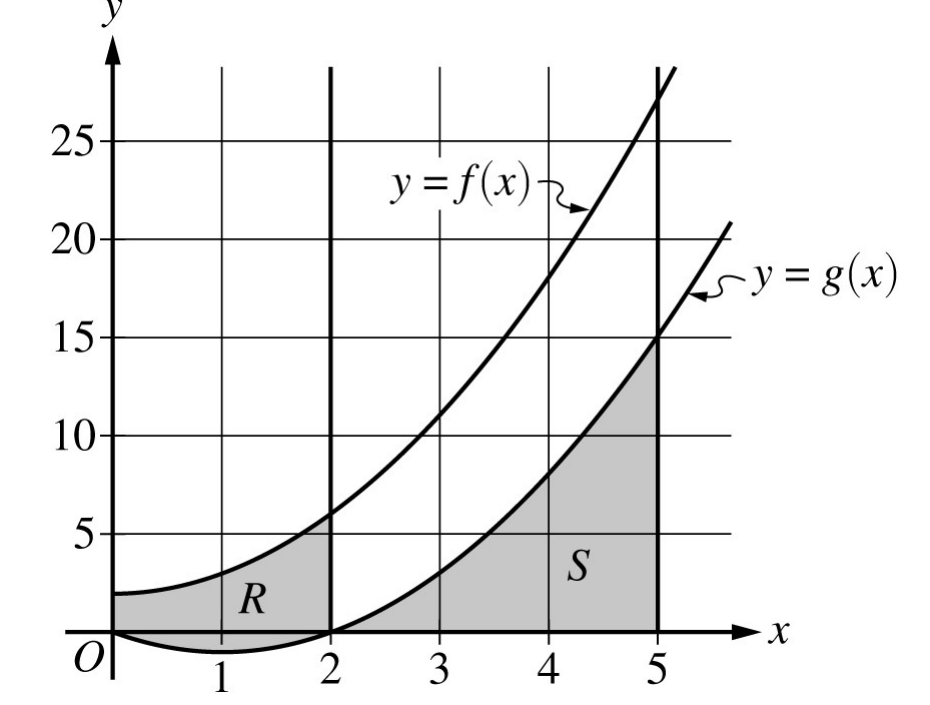
The functions ff and gg are defined by f(x)=x2+2f(x)=x^2+2 and g(x)=x2−2xg(x)=x^2-2x, as shown in the graph.
2024 AP Calculus AB FRQ Question 6 Graph of f and g, with regions R and S
Graphs of $f$ and $g$, with regions $R$ (on $[0,2]$) and $S$ (on $[2,5]$).
Part AMedium2 points
Let RR be the region bounded by the graphs of ff and gg, from x=0x=0 to x=2x=2, as shown in the graph. Write, but do not evaluate, an integral expression that gives the area of region RR.

Answer

Area=∫02(f(x)−g(x)) dx\text{Area}=\displaystyle\int_0^2 (f(x)-g(x))\,dx
Full Solution & Work

Set up the integrand

Since f(x)≥g(x)f(x) \geq g(x) on [0,2][0,2] (the two parabolas differ by f(x)−g(x)=2x+2f(x)-g(x)=2x+2, positive for x≥−1x\geq -1):

Write the area integral

Area=∫02(f(x)−g(x)) dx\text{Area} = \int_0^2 \big(f(x)-g(x)\big)\,dx

AP Scoring — 2 Points

**P1**: An integrand of f(x)−g(x)f(x)-g(x), ∣f(x)−g(x)∣|f(x)-g(x)|, g(x)−f(x)g(x)-f(x), or ∣g(x)−f(x)∣|g(x)-f(x)| in one or more definite integrals (or, equivalently, a difference of definite integrals with integrands f(x)f(x) and g(x)g(x)).
**P2**: Earned only for one or more integrals equivalent to
∫02(f(x)−g(x)) dx\int_0^2(f(x)-g(x))\,dx.
Part BHard4 points
Let SS be the region bounded by the graph of gg and the xx-axis, from x=2x=2 to x=5x=5, as shown in the graph. Region SS is the base of a solid. For this solid, at each xx the cross section perpendicular to the xx-axis is a rectangle with height equal to half its base in region SS. Find the volume of the solid. Show the work that leads to your answer.

Answer

V=4145V=\dfrac{414}{5}
Full Solution & Work

Set up the volume integral

V=∫2512(g(x))2 dx=∫2512(x2−2x)2 dxV = \int_2^5 \frac{1}{2}\big(g(x)\big)^2\,dx = \int_2^5 \frac{1}{2}(x^2-2x)^2\,dx

Expand and integrate

=12∫25(x4−4x3+4x2) dx=12[x55−x4+4x33]25= \frac{1}{2}\int_2^5 (x^4-4x^3+4x^2)\,dx = \frac{1}{2}\left[\frac{x^5}{5}-x^4+\frac{4x^3}{3}\right]_2^5

Evaluate the antiderivative at the bounds

=12[(555−54+5003)−(325−16+323)]=12(5003−1615)=4145= \frac{1}{2}\left[\left(\frac{5^5}{5}-5^4+\frac{500}{3}\right)-\left(\frac{32}{5}-16+\frac{32}{3}\right)\right] = \frac{1}{2}\left(\frac{500}{3}-\frac{16}{15}\right) = \frac{414}{5}

AP Scoring — 4 Points

**P1**: An integrand of the form k(g(x))2k(g(x))^2 in a definite integral, for any nonzero constant kk.
**P2**: Limits of
x=2x=2 and x=5x=5 in a definite integral with integrand a(x)⋅g(x)a(x)\cdot g(x) for any nonzero factor a(x)a(x).
**P3**: A correct antiderivative of
k(x2−2x)nk(x^2-2x)^n for some integer n≥2n\geq2.
**P4**: Earned only for the numeric answer
4145\frac{414}{5} (equivalent to 12(5003−1615)\frac{1}{2}\left(\frac{500}{3}-\frac{16}{15}\right)).

Common mistake: A response that instead uses $f(x)$ in place of $g(x)$ throughout the setup (Volume $=\int_2^5 \frac12(f(x))^2 dx$) can still earn P1 and P2, but is not eligible for P3 or P4 — the cross sections are explicitly built on region $S$, which is bounded by $g$, not $f$.

Part CHard3 points
Write, but do not evaluate, an integral expression that gives the volume of the solid generated when region SS, as described in part (b), is rotated about the horizontal line y=20y=20.

Answer

V=π∫25[202−(20−g(x))2] dxV=\pi\int_2^5 \Big[20^2-\big(20-g(x)\big)^2\Big]\,dx
Full Solution & Work

Identify outer and inner radii

Rotating about y=20y=20: the outer radius (to the xx-axis, the far boundary of SS) is 20−0=2020-0=20; the inner radius (to g(x)g(x), the near boundary) is 20−g(x)20-g(x).

Apply the washer method

V=π∫25[202−(20−g(x))2] dx=π∫25[400−(20−(x2−2x))2] dxV = \pi\int_2^5 \Big[20^2-\big(20-g(x)\big)^2\Big]\,dx = \pi\int_2^5\Big[400-\big(20-(x^2-2x)\big)^2\Big]\,dx

AP Scoring — 3 Points

**P1**: An integrand of 202−(20−g(x))220^2-(20-g(x))^2 (or an equivalent expression, in any order/sign combination) in one or more definite integrals.
**P2**: Earned only for an integrand mathematically equivalent to
202−(20−g(x))220^2-(20-g(x))^2 — a response using f(x)f(x) in place of g(x)g(x) can still earn P1 but not P2.
**P3**: Earned only for a definite integral including the constant
π\pi and limits x=2x=2 to x=5x=5 (limits reversed to 55 to 22 also work, provided the sign is adjusted accordingly).

Study the concept

Learn the theory behind this question type with worked examples and strategy tips.

Practice More
Gary Chang

Gary Chang

Calculus Educator

5+ Years of Calculus Teaching Experience | AP Calculus Specialist. Dedicated to helping students master calculus through step-by-step logic and clear visualizations.

Finished reviewing?

Keep your momentum going