2025 AP Calculus AB Free-Response Questions — Full Solutions
Complete worked solutions with scoring breakdowns for all 6 FRQs
Questions 1–2 (Part A, 30 min) permit a graphing calculator. Questions 3–6 (Part B, 60 min) do not.
Question 1
Calculator OKInvasive Species Spread Rate
Rate, Average Value & Optimization
Open this question on its own pageAnswer
Full Solution & Work
Apply the average value formula
Evaluate with a calculator
From to weeks, the average number of acres affected was **2.778 acres**.
AP Scoring — 2 Points
**P2**: Correct answer 2.778, accurate to three decimal places.
Answer
Full Solution & Work
Find the average rate of change of C on [0,4]
(since and )
Set the instantaneous rate equal to it and solve
Solving with a calculator: .
AP Scoring — 2 Points
**P2**: Correct answer , supported by the equation .
Common mistake: Presenting only "$t = 1.282$" without the supporting equation earns neither point — the average rate of change and the equation $C'(t) = \text{average rate}$ must both appear.
Answer
Full Solution & Work
Write the limit of the rate function
Evaluate
AP Scoring — 2 Points
**P2**: Correct value 0.
Common mistake: A very common slip: writing $\lim_{t\to\infty} C(t)$ instead of $C'(t)$. The question asks about the *rate of change*, so it must be the derivative inside the limit.
Answer
Full Solution & Work
Differentiate A using FTC
Set A'(t) = 0 and solve
Solving numerically: .
Candidates test
The largest value of occurs at .
AP Scoring — 3 Points
**P2**: A complete justification — either a candidates-test table evaluating , , , or a sign analysis of around .
**P3**: Correct final answer (or 11.441), supported by the work above.
Common mistake: A first- or second-derivative test alone (a *local* argument) does not earn the justification point on a closed-interval max/min question — AP requires a *global* argument: either compare $A$ at all candidates (endpoints + critical points), or show $A'$ changes from $+$ to $-$ specifically at $t=11.442$ and note it's the only critical point in the interval.
Study the concept
Learn the theory behind this question type with worked examples and strategy tips.
Question 2
Calculator OKArea and Volume Between f and g
Area & Volume
Open this question on its own page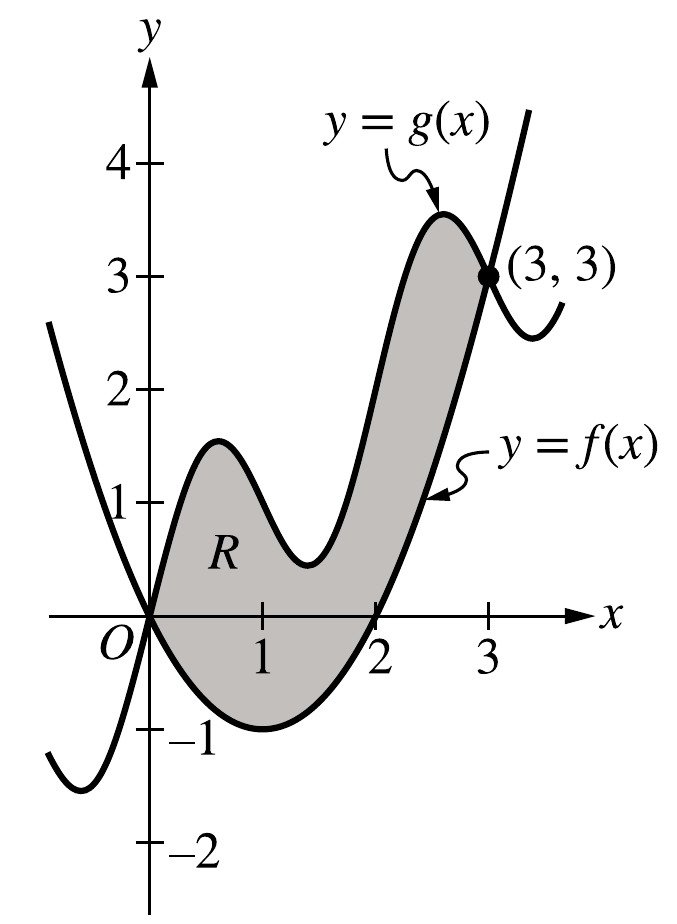
Answer
Full Solution & Work
Set up the integral
Evaluate with a calculator
The area of is **5.137** (or 5.136).
AP Scoring — 2 Points
**P2**: Correct answer 5.137 (or 5.136).
Answer
Full Solution & Work
Identify the cross-sectional area
Integrate over [0,3] and evaluate
The volume of the solid is **7.705** (or 7.704).
AP Scoring — 2 Points
**P4**: Correct answer 7.705 (or 7.704). The presence of is not required for scoring.
Answer
Full Solution & Work
Identify outer and inner radii
Apply the washer method
AP Scoring — 3 Points
**P6**: The correct integrand (or equivalent).
**P7**: Correct limits , the constant , and the differential — all present together. (A response missing can still earn P5–P6 but not P7.)
Answer
Full Solution & Work
Set the two derivatives equal
Solve numerically
AP Scoring — 2 Points
**P9**: Correct answer (or 0.675).
Study the concept
Learn the theory behind this question type with worked examples and strategy tips.
Question 3
No CalculatorReading Rates — Table Data
Rate & Data from Tables
Open this question on its own pageValues of R(t)
| t (minutes) | 0 | 2 | 8 | 10 |
|---|---|---|---|---|
| R(t) (words per minute) | 90 | 100 | 150 | 162 |
Answer
Full Solution & Work
Set up the difference quotient
State the units
AP Scoring — 2 Points
**P2**: Correct units — "words per minute per minute" (or words/minute²), whether or not attached to a numerical value.
Answer
Full Solution & Work
Establish continuity
Compare 155 to the endpoint values
Apply the Intermediate Value Theorem
AP Scoring — 2 Points
**P4**: Indicates (or equivalently uses or ) and , and answers "yes." (P4 does not require P3 to be earned.)
Common mistake: You don't have to name the Intermediate Value Theorem to earn credit, but if you do name a theorem, it must be the correct one — citing the Mean Value Theorem here is a common and costly mix-up.
Answer
Full Solution & Work
Set up the trapezoidal sum
Substitute values and compute
AP Scoring — 2 Points
**P6**: Correct answer 1252, with supporting work. To be eligible for P6, P5 must be earned. A fully correct left or right Riemann sum (1080 or 1424) earns P5 but **not** P6 — it isn't a trapezoidal sum.
Answer
Full Solution & Work
Set up the integral
Find the antiderivative
Evaluate
The teacher has read **1300 words** by the end of the 10 minutes.
AP Scoring — 3 Points
**P8**: Correct antiderivative .
**P9**: Correct final answer 1300, with P8 required to be eligible.
Study the concept
Learn the theory behind this question type with worked examples and strategy tips.
Question 4
No CalculatorAccumulation Function from a Graph
Graph Analysis & Curve Sketching
Open this question on its own page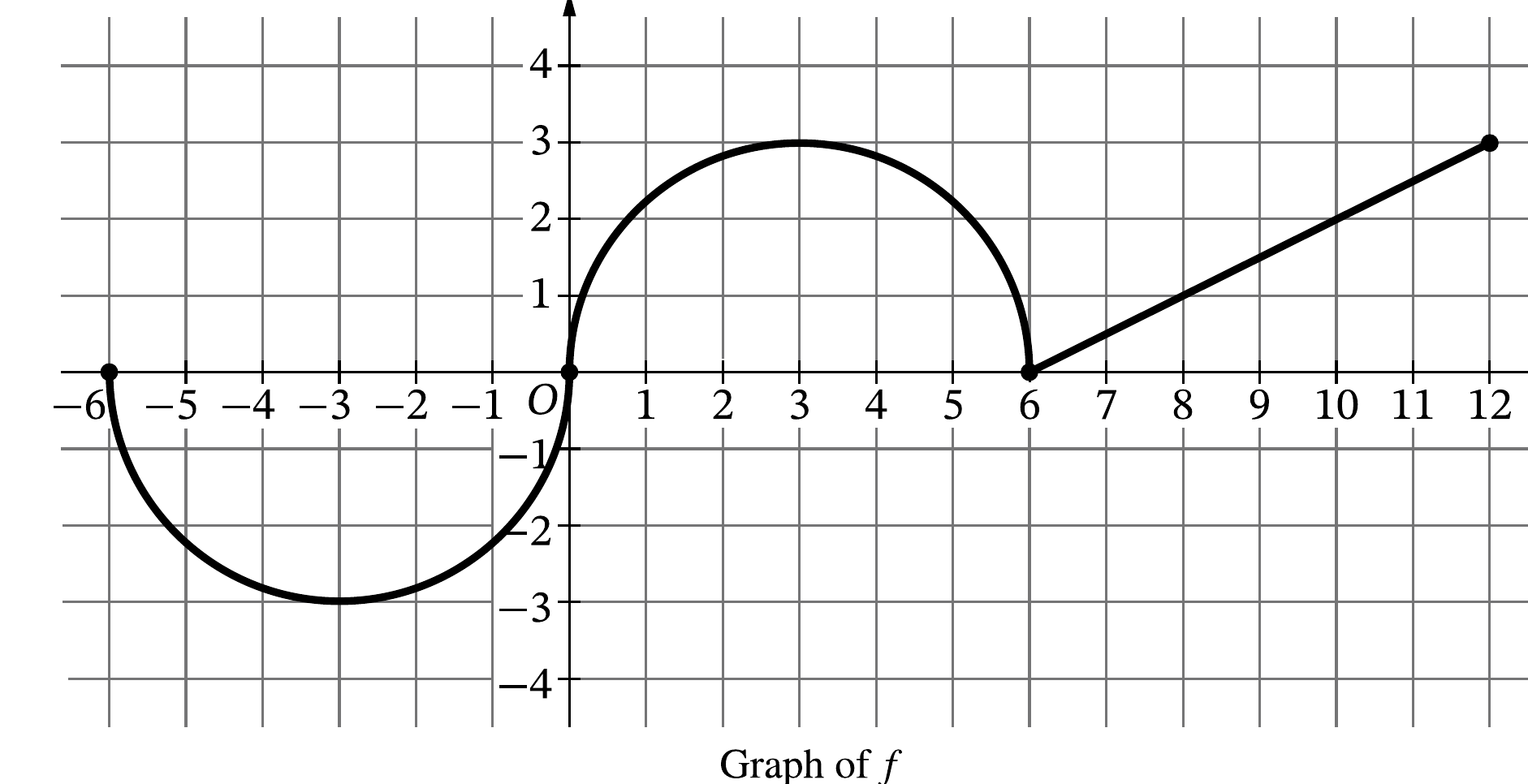
Answer
Full Solution & Work
Apply the Fundamental Theorem of Calculus
Evaluate f(8) from the line segment
AP Scoring — 2 Points
**P2**: Correct answer . (An implied use of FTC, like writing directly by reading the graph, can also earn P2 without P1.)
Answer
Full Solution & Work
Relate inflection points of g to f
Read local extrema off the graph of f
At : increases (right semicircle going up) then decreases (coming back down) — a local maximum of .
At : is still decreasing just before (end of the upper semicircle) and increasing just after (start of the line segment) — another local minimum of , even though the graph has a corner there.
Conclusion
AP Scoring — 2 Points
**P4**: A reason tied to the given graph of (e.g. " changes from increasing to decreasing / decreasing to increasing there", or " has a local extremum there"). A reason based on an ambiguous "the function" or "the graph," without specifying , does not earn P4.
Common mistake: The corner at $x=6$ is easy to miss — students often only report $x=-3$ and $x=3$ since those look like the "obvious" smooth extrema, but $f$ still switches from decreasing to increasing there, so $g$ still has an inflection point.
Answer
Full Solution & Work
Compute g(12) as a signed area
(area of the triangle under the line segment from to )
Compute g(0) as a signed area
(the upper semicircle from to has area ; the direction of integration flips the sign)
AP Scoring — 2 Points
**P6**: , with or without supporting work. Both values must be clearly labeled — unlabeled numbers do not earn credit.
Answer
Full Solution & Work
Find critical points of g
Evaluate g at all candidates
(using , and the values of , from part C)
Conclusion
AP Scoring — 3 Points
**P8**: A complete justification — a candidates-test table evaluating at , , , (values may be imported from part C), or an equivalent global sign argument.
**P9**: Correct answer .
Study the concept
Learn the theory behind this question type with worked examples and strategy tips.
Answer
Full Solution & Work
Differentiate x_H(t) with the Chain Rule
Evaluate at t = 1
AP Scoring — 2 Points
**P2**: Correct answer . An unsupported answer of alone earns P2 but not P1.
Answer
Full Solution & Work
Analyze the sign of v_H(t)
for (moving left); for (moving right).
Analyze the sign of v_J(t)
For : , so , and , giving (moving left).
For : , so , giving (moving right).
Compare directions
: left on , right on .
The signs disagree only on : is still moving left there while has already turned right.
AP Scoring — 3 Points
**P4**: A correct sign/direction analysis for at least one of the two particles on .
**P5**: Correct analyses for **both** particles, leading to the answer .
Answer
Full Solution & Work
Find the sign of v_J(2)
Compare signs of velocity and acceleration
AP Scoring — 1 Point
Answer
Full Solution & Work
Set up position as initial position + accumulated change
Substitute u = t² − 1
Combine
AP Scoring — 3 Points
**P8**: A correct antiderivative of the form (equivalently) with — a different constant forfeits eligibility for P9.
**P9**: Correct final answer , requiring P8.
Study the concept
Learn the theory behind this question type with worked examples and strategy tips.
Question 6
No CalculatorImplicit Curve — Tangent Lines & Related Rates
Implicit Differentiation
Open this question on its own pageAnswer
Full Solution & Work
Differentiate both sides implicitly
Solve for dy/dx
AP Scoring — 2 Points
**P2**: Algebraic verification that isolates to reach the given expression — earned only if P1 was earned. Presenting is sufficient, provided no later error appears.
Answer
Full Solution & Work
Find the slope at (2, −1)
Apply the tangent line approximation
AP Scoring — 2 Points
**P4**: Correct tangent-line approximation, clearly evaluated at : .
Answer
Full Solution & Work
A vertical tangent occurs where dy/dx is undefined
Solve for y
Apply the y > 0 restriction
AP Scoring — 2 Points
**P6**: Correct answer , clearly identified as the only solution satisfying (earned only if P5 was earned, and only if the algebra to isolate is correct).
Answer
Full Solution & Work
Differentiate implicitly with respect to t
Substitute the known values
Solve for dy/dt
AP Scoring — 3 Points
**P8**: A correct equation equivalent to — requires P7 with no errors.
**P9**: Correct final value , requiring both P7 and P8.
Common mistake: An equally valid alternate route: solve $\frac{dy}{dx}$ implicitly with respect to $x$ first, evaluate it at $(4,1)$ to get $-\frac{2}{9}$, then multiply by $\frac{dx}{dt}=3$ using the chain rule $\frac{dy}{dt}=\frac{dy}{dx}\cdot\frac{dx}{dt}$.
Study the concept
Learn the theory behind this question type with worked examples and strategy tips.

Gary Chang
Calculus Educator5+ Years of Calculus Teaching Experience | AP Calculus Specialist. Dedicated to helping students master calculus through step-by-step logic and clear visualizations.
Finished reviewing?