What Does dx Mean in Calculus? (Simple Explanation with Examples)
Confused about what dx means in calculus? Learn the simple meaning of dx in derivatives and integrals with clear examples.
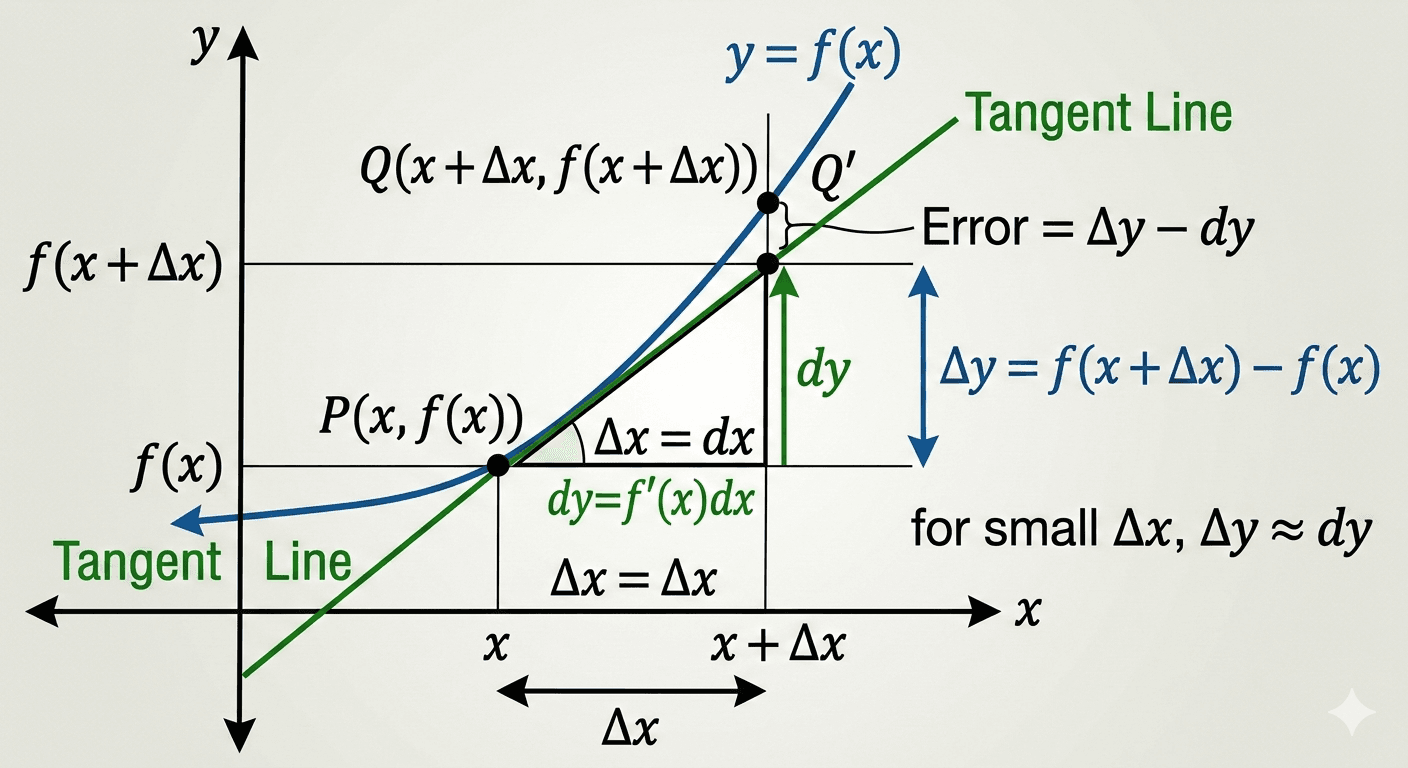
- Change along the Curve (): The blue double-headed arrow indicates the actual change in the function value along the blue curve, , as increases by .
- Change along the Tangent Line (): The solid green arrow represents the change along the green tangent line at point , defined as (where ).
In Calculus, is not just a punctuation mark at the end of an integral. It represents a 'Differential'—a tangible, independent variable representing a small change in x.
Definition of Differential: If , the differential is defined as . Here, is an independent variable, and is the estimated change in along the tangent line.
Definition of Differential: If , the differential is defined as . Here, is an independent variable, and is the estimated change in along the tangent line.
Practice Exercises
Example 01Medium
Compare the actual change with the differential for when x changes from 2 to 2.05.
NEED A HINT?
Identify and . Calculate using the derivative formula .
SHOW DETAILED EXPLANATION
Step 1: Find the Derivative
. At , .
Step 2: Calculate dy (Linear Estimate)
Using the definition . Since , .
Step 3: Compare with Actual Change
The actual change . The differential (0.7) is a very close approximation of because when is small.
Example 02Easy
A sphere's radius is measured as 21cm with a possible error of 0.05cm. Estimate the error in the calculated volume.
NEED A HINT?
Use differentials to estimate error propagation. Here, (the error in radius) corresponds to . You need to find .
SHOW DETAILED EXPLANATION
Step 1: Volume Formula
. We need to find the differential .
Step 2: Differentiate
Take the differential of both sides: .
Step 3: Substitute Values
Plug in and . . This calculation shows how a small input 'dx' (or dr) scales into an output change 'dy' (or dV).
Common Pitfalls
- ⚠dx is NOT ZeroA common mistake is thinking dx = 0 because it's 'infinitesimally small'. In Calculus, dx is an approach to zero, not zero itself. If it were zero, dy/dx would be undefined!
- ⚠Thinking dy/dx is always a literal fractionWhile you can often treat it as a fraction (like in separation of variables), remember it is formally a limit. Don't just cancel 'd's—that's a cardinal sin in math!
Frequently Asked Questions
What does dx actually mean in calculus?
In calculus, dx represents an infinitesimally small change in x. It indicates the variable with respect to which differentiation or integration is performed. In derivatives, it appears in notation like dy/dx to describe a rate of change. In integrals, dx specifies the variable of integration.
Why can we treat dy/dx like a fraction?
Although dy/dx is formally defined as a limit, it behaves like a fraction in many contexts. This is because derivatives can be interpreted as ratios of infinitesimal changes. In advanced mathematics, differential forms justify why treating dy and dx as separate quantities often produces correct results.
Can you cancel dx in an equation?
In many practical calculations, dx can be manipulated algebraically and may appear to cancel. However, strictly speaking, dx is not just a number but part of a limit definition. The reason cancellation works is due to the structure of differential notation and the way derivatives are defined.
What is the difference between dx and Δx?
Δx represents a finite change in x, while dx represents an infinitesimally small change. Δx is used in difference quotients and approximations, whereas dx is used in derivatives and integrals to describe instantaneous change.
What does dx mean in an integral?
In an integral, dx specifies the variable of integration and represents an infinitesimal width of a small slice. For example, in ∫f(x) dx, the dx indicates that the function is being integrated with respect to x.
Ready to test it?
Practice Derivatives multiple-choice questions, timed and fully explained.

Gary Chang
Calculus Educator5+ Years of Calculus Teaching Experience | AP Calculus Specialist. Dedicated to helping students master calculus through step-by-step logic and clear visualizations.
Recommended Learning Path
Want a Structured Way to Score a 5 in ap calculus ab?
Don not learn in fragments. Follow our proven 30-day roadmap that connects every concept from Limits to Integrals.
Start Your 30-Day Journey →Join thousands of students mastering AP Calculus with us.