Free Response · Visualizing slopes and solving for particular solutions
[2026] Differential Equations & Slope Fields AP Calculus AB FRQ: Explained with Practice & Scoring Tips
You will typically be asked to sketch a slope field, write an equation for a tangent line to approximate a value, and use separation of variables to find a specific solution y = f(x) given an initial condition.
On this page
Key Formulashover to see usage
- Slope Field (Differential Equation)When to useAt each given point (x, y), calculate the numerical value of the derivative and draw a short line segment with that slope.
- Separation of VariablesWhen to useUsed to solve . You MUST move all y terms to the dy side and all x terms to the dx side before integrating.
- Tangent Line ApproximationWhen to useUse the given point and calculate to find the linear approximation .
- Particular SolutionWhen to useAfter integrating, use the initial condition to solve for the constant of integration .
Step-by-Step SOP
- 1
1. Sketching the Slope Field
Plug the coordinates of each indicated dot into the differential equation. Draw segments. Remember: slope 0 is horizontal; undefined slope (like 1/0) means no segment or a vertical dash (though usually left blank in AP). - 2
2. Linear Approximation
Identify the point of tangency. Compute the slope at that point. Write the tangent line equation and plug in the 'nearby' x-value to estimate y. - 3
3. Separate, Integrate, and Solve (The Big Step)
Move the y-terms to the left (by division/multiplication) and dx to the right. Integrate both sides. **Immediately** add '+ C' to the side with x. - 4
4. Solve for C and Find the Domain
Plug in the initial condition to find the value of C. Then, isolate y to get the final function. Check if the solution is valid for the interval containing .
Question 1
2024 AP Calculus AB Exam — FRQ 3
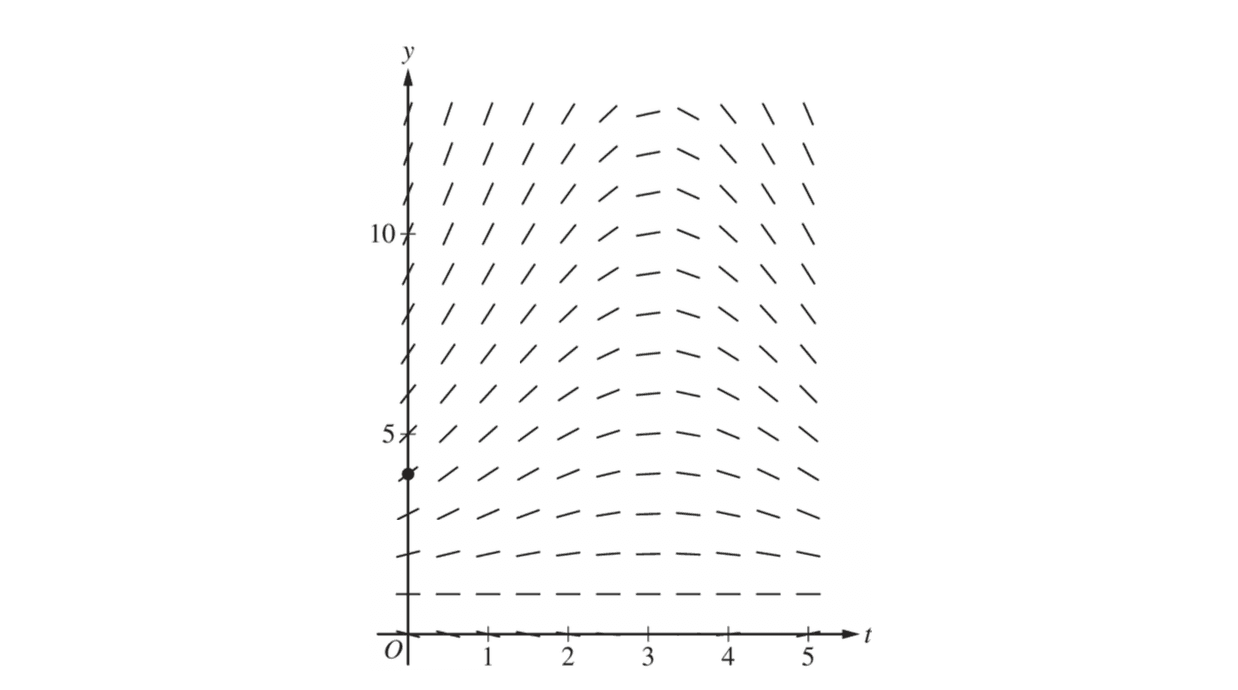
The depth of seawater at a location can be modeled by the function that satisfies the differential equation , where is measured in feet and is measured in hours after noon (). It is known that .
APart A
EasyA portion of the slope field for the differential equation is provided. Sketch the solution curve, , through the point (0, 4).
Need a Hint?
Start at the point (0, 4) and follow the flow of the slope segments. Ensure the curve is smooth and extends across the requested interval.
Show Solution
Plot the Initial Condition
Identify and mark the point on the y-axis.
Sketch the Curve
Draw a curve passing through that remains tangent to the nearby slope lines. The curve should increase, reach a peak near , and then decrease.

AP Scoring Note — 1 Point
Earned for a solution curve that passes through , extends to at least , and follows the general direction of the slope segments without obvious conflicts.
BPart B
MediumFor , it can be shown that . Find the value of , for , at which has a critical point. Determine whether the critical point corresponds to a relative minimum, a relative maximum, or neither. Justify your answer.
Need a Hint?
Critical points occur where . Since , focus on where . Use the first derivative test to justify the relative extremum.
Show Solution
Find the Critical Point
Set . Since (given ), we solve . In the interval , this occurs when , so .
Perform the First Derivative Test
For , , so (H is increasing). For , , so (H is decreasing).
Conclusion and Justification
Since changes from positive to negative at , has a relative maximum at .
AP Scoring Note — 3 Points
P1 (Sign Analysis): Considering the sign of or .
P2 (Identify t): Correctly finding .
P3 (Justification): Providing a correct justification and conclusion of 'relative maximum'.
P2 (Identify t): Correctly finding .
P3 (Justification): Providing a correct justification and conclusion of 'relative maximum'.
CPart C
HardUse separation of variables to find , the particular solution to the differential equation with initial condition .
Need a Hint?
Separate terms to the left and terms to the right. Integrate both sides, add , and solve for using before isolating .
Show Solution
Separate Variables
Integrate Both Sides
Solve for Constant C
Using :
Solve for H(t)
Final Expression
AP Scoring Note — 5 Points
P1 (Separation): 1 pt for correct separation.
P2 & P3 (Antiderivatives): 1 pt for each correct side.
P4 (C and Initial Condition): 1 pt for and substituting .
P5 (Answer): 1 pt for the final function. **Note: No separation = 0/5.**
P2 & P3 (Antiderivatives): 1 pt for each correct side.
P4 (C and Initial Condition): 1 pt for and substituting .
P5 (Answer): 1 pt for the final function. **Note: No separation = 0/5.**
Question 2
2023 AP Calculus AB Exam — FRQ 3
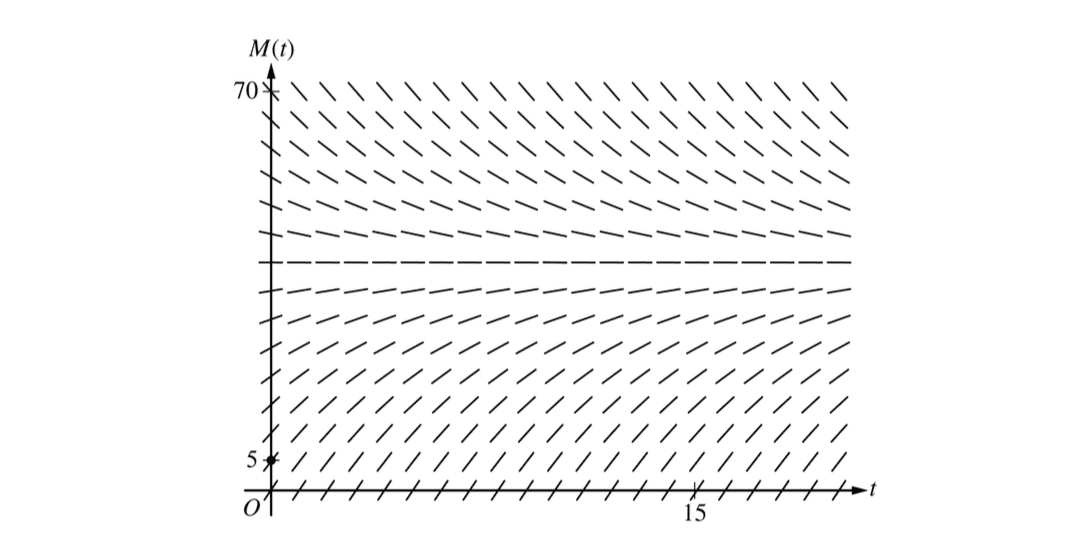
A bottle of milk is taken out of a refrigerator and placed in a pan of hot water to be warmed. The increasing function models the temperature of the milk at time , where is measured in degrees Celsius () and is the number of minutes since the bottle was placed in the pan. satisfies the differential equation . At time , the temperature of the milk is . It can be shown that for all values of .
APart A
EasyA slope field for the differential equation is shown. Sketch the solution curve through the point (0, 5).
Need a Hint?
Start at (0, 5). Since dM/dt is positive but decreasing as M approaches 40, the curve should be concave down and level off at the horizontal asymptote M = 40.
Show Solution
Initial Point
Identify the point on the vertical axis.
Sketching the Curve
Draw a smooth curve that follows the slope segments, increasing from and asymptotically approaching the dashed line at .

AP Scoring Note — 1 Point
The curve must pass through , follow the slope lines, and stay entirely below the line.
BPart B
EasyUse the line tangent to the graph of at to approximate , the temperature of the milk at time minutes.
Need a Hint?
Find the slope at t=0 by plugging M=5 into the differential equation. Then use the point-slope form.
Show Solution
Calculate the Slope
At , . .
Tangent Line Equation
.
Approximate M(2)
.
AP Scoring Note — 2 Points
1 pt for the correct slope () and 1 pt for the final approximation ().
CPart C
MediumWrite an expression for in terms of . Use it to determine whether the approximation from part (b) is an underestimate or an overestimate for the actual value of . Give a reason for your answer.
Need a Hint?
Differentiate the first derivative with respect to t. Remember that dM/dt itself is 1/4(40-M).
Show Solution
Find the Second Derivative
.
Determine Concavity
Since , is always positive. Therefore, .
Conclusion
Because , the graph of is concave down. A tangent line approximation for a concave down graph is an **overestimate**.
AP Scoring Note — 2 Points
1 pt for the correct expression of and 1 pt for the correct conclusion with reason (concavity).
DPart D
HardUse separation of variables to find an expression for , the particular solution to the differential equation with initial condition .
Need a Hint?
This is the 'Big Step'. Move (40-M) to the dM side and dt to the other. Watch the negative sign during integration!
Show Solution
Separate Variables
.
Integrate
.
Use Initial Condition (0, 5)
.
Solve for M
.
Final Particular Solution
.
AP Scoring Note — 4 Points
1 pt: Separation; 1 pt: Antiderivatives; 1 pt: Constant and initial condition; 1 pt: Solving for . No separation = 0/4.
Timed Practice
Ready to challenge yourself?
Take a 20-minute timed mock exam to test your understanding.
Common Pitfalls
- ⚠The '+ C' CatastropheIf you forget '+ C' during integration, you lose almost all points for that part (often 0/5 or 0/6). You must add it the moment you integrate.
- ⚠Failure to Separate VariablesIf you don't separate variables (e.g., trying to integrate as ), you get 0 points for the entire section. Separation is the first priority.
- ⚠The Absolute Value in ln|y|When , don't forget the absolute value. When solving for y, use the initial condition to determine if the expression inside is positive or negative (i.e., whether or ).
- ⚠Algebraic Errors in Isolating yBe careful with exponentiation. becomes (where the new C is ), not .
- ⚠Slope Field PrecisionEnsure that slopes of 0 are perfectly horizontal and that positive/negative slopes are clearly distinguished. Comparison matters: a slope of 2 should look steeper than a slope of 1.
You Might Also Like

Gary Chang
Calculus Educator5+ Years of Calculus Teaching Experience | AP Calculus Specialist. Dedicated to helping students master calculus through step-by-step logic and clear visualizations.