Free Response · Integrating between curves and rotating around axes
[2026] AP Calculus Area & Volume FRQ: Setup Guide & Essential Formulas
You are given two functions, f(x) and g(x), which bound a region R (or S). You will be asked to find the area of the region, the volume of a solid with given cross-sections, and the volume of a solid of revolution using the Washer or Disc method.
On this page
Key Formulashover to see usage
- Area Between Two CurvesWhen to useIdentify which function is on top. If the functions intersect, find the intersection points (limits of integration a and b).
- Volume with Known Cross-SectionsWhen to useThe area A(x) depends on the shape. For a square: ; For a semi-circle: ; For a rectangle: .
- Washer Method (Rotation around y = k)When to useUsed when there is a 'hole'. Outer Radius ;
Inner Radius . - Disc Method (Rotation around y = k)When to useA special case of Washer Method where the region is flushed against the axis of rotation.
Step-by-Step SOP
- 1
1. Sketch and Identify the Region
Graph f(x) and g(x). Label intersection points as a and b. Determine which is 'Top' and which is 'Bottom' (or 'Right' vs 'Left'). - 2
2. Set up the Integrand for Area
Always use integral of (Top - Bottom) dx. If you must integrate with respect to y, use integral of (Right - Left) dy. - 3
3. Build the Cross-Sectional Area A(x)
Find the 'length' of the base in the region, usually s = f(x) - g(x). Plug this s into the geometry formula (e.g., if cross-section is a rectangle of height H, A(x) = s * H). - 4
4. Apply the 'Big R, Little r' Strategy
For rotations, draw a line from the axis of rotation into the region. The further curve is R(x), the closer curve is r(x). Radius = |Function - Axis|.
Question 1
2025 AP Calculus AB Exam — FRQ 2
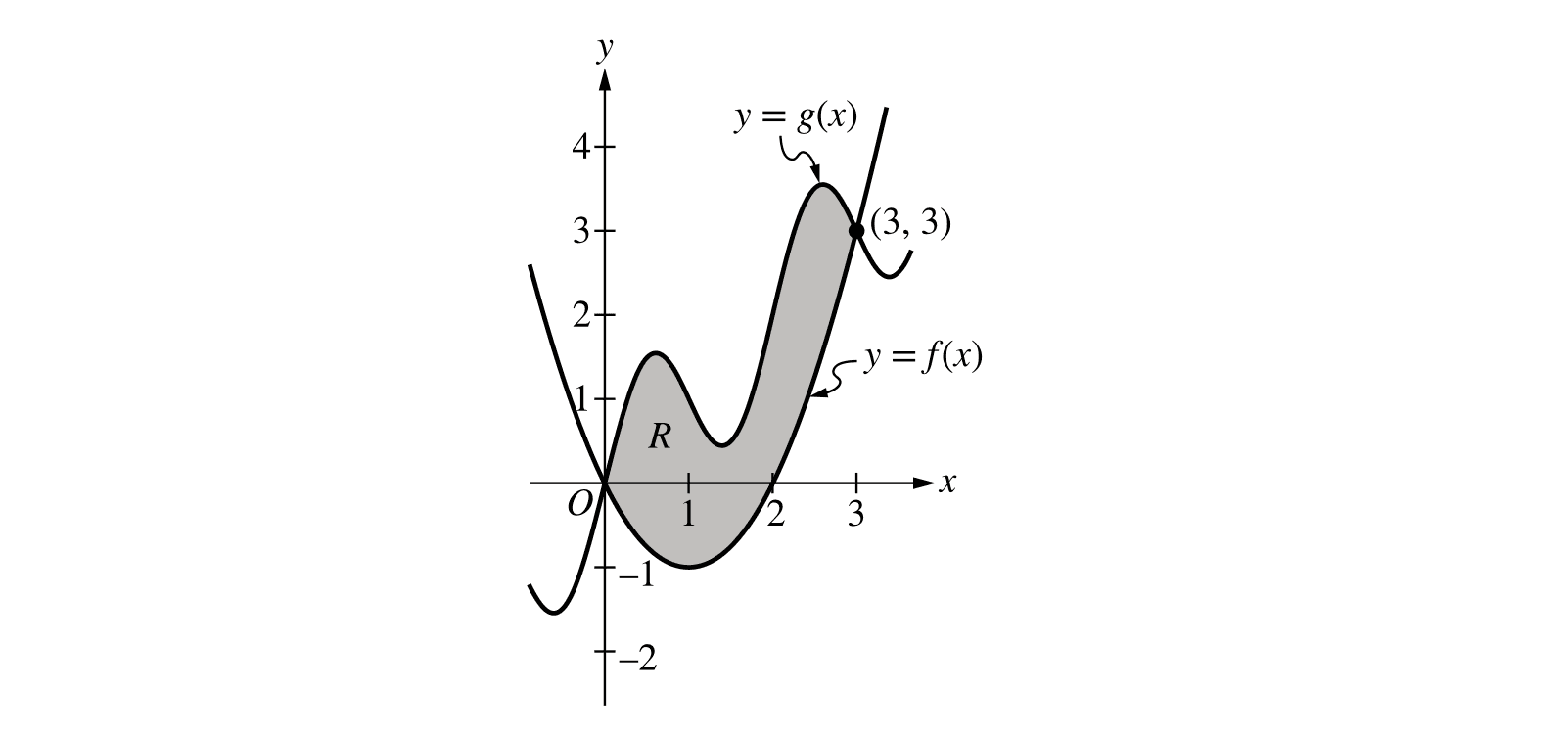
The shaded region is bounded by the graphs of the functions and , where and , as shown in the figure. (Note: Your calculator should be in radian mode.)
APart A
EasyFind the area of . Show the setup for your calculations.
Need a Hint?
Area = . Looking at the graph, is above from to .
Show Solution
Set up the integral
Evaluate the definite integral
Using a calculator: (or 5.136).
AP Scoring Note — P1 + P2
P1 (Form): Earned for a correct integrand of or with limits 0 to 3.
P2 (Answer): Correct numerical value to 3 decimal places. Note: If you swapped top/bottom but took the absolute value to get 5.137, you still earn both points.
P2 (Answer): Correct numerical value to 3 decimal places. Note: If you swapped top/bottom but took the absolute value to get 5.137, you still earn both points.
BPart B
MediumRegion is the base of a solid. For this solid, at each the cross section perpendicular to the -axis is a rectangle with height and base in region . Find the volume of the solid. Show the setup for your calculations.
Need a Hint?
Volume = . Here, . The base is the vertical distance and the height is given as .
Show Solution
Set up the area function A(x)
Integrate to find Volume
Evaluate
(or 7.704).
AP Scoring Note — P3 + P4
P3 (Form): Earned for an integrand that is a product of and .
P4 (Answer): Correct numerical value. Missing the factor or using (square cross-section) will lose these points.
P4 (Answer): Correct numerical value. Missing the factor or using (square cross-section) will lose these points.
CPart C
HardWrite, but do not evaluate, an integral expression for the volume of the solid generated when the region is rotated about the horizontal line .
Need a Hint?
Use the Washer Method: . The axis is below the region. Outer radius , Inner radius .
Show Solution
Identify Radii
\\
Set up the Washer integral
AP Scoring Note — P5 + P6 + P7
P5 (Inner/Outer): Earned for correct form.
P6 (Integrand): Earned for the specific terms and .
P7 (Limits/Constant): Must include , limits to , and . If you forget , you cannot earn P7.
P6 (Integrand): Earned for the specific terms and .
P7 (Limits/Constant): Must include , limits to , and . If you forget , you cannot earn P7.
DPart D
MediumIt can be shown that . Find the value of , for , at which the line tangent to the graph of is parallel to the line tangent to the graph of .
Need a Hint?
Parallel tangent lines mean the slopes are equal: . Find and set it equal to the given .
Show Solution
Find f'(x)
Set slopes equal
Solve for x
Using a calculator to find the intersection in the interval : (or 0.675).
AP Scoring Note — P8 + P9
P8 (Equation): Earned for setting .
P9 (Answer): Correct value. You must show the equation first to earn the answer point.
P9 (Answer): Correct value. You must show the equation first to earn the answer point.
Question 2
2024 AP Calculus AB Exam — FRQ 6
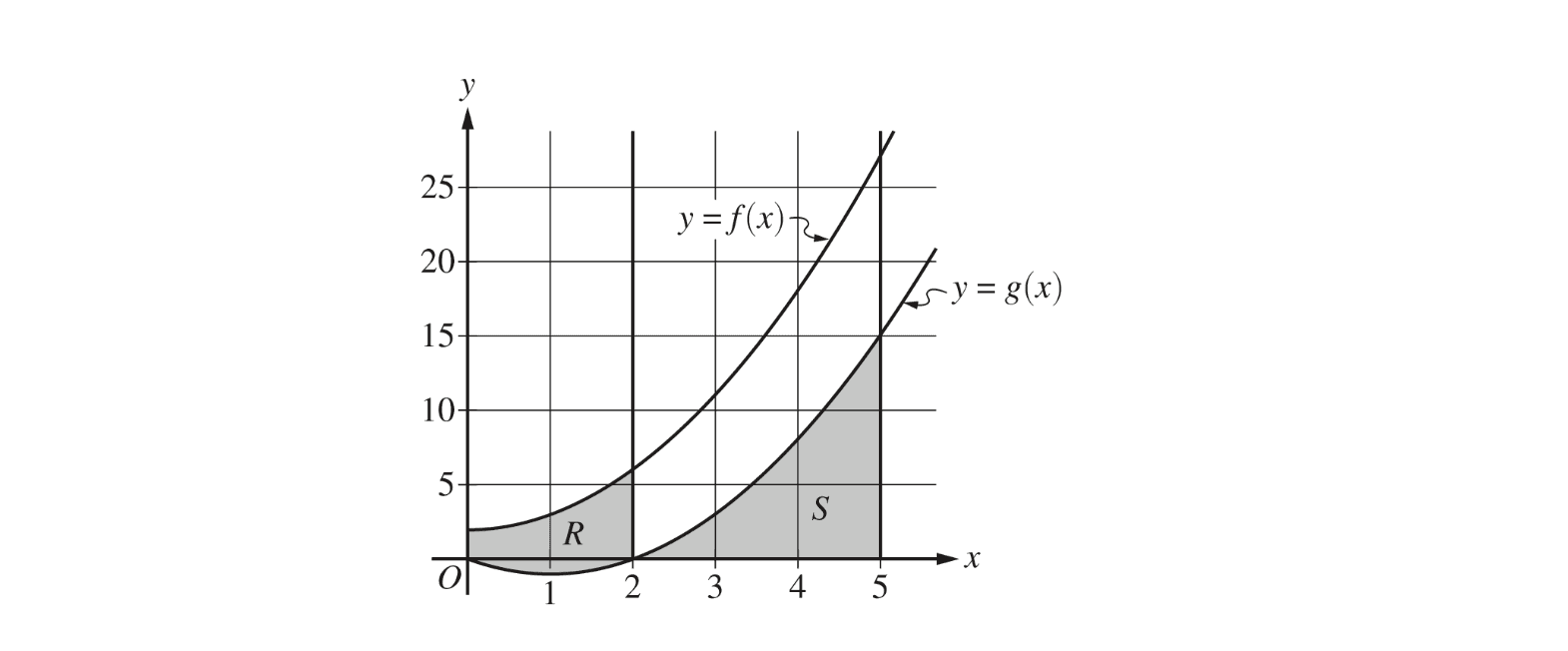
The functions and are defined by and , as shown in the graph. Region is bounded by and from to . Region is bounded by and the -axis from to .
APart A
EasyLet be the region bounded by the graphs of and , from to , as shown in the graph. Write, but do not evaluate, an integral expression that gives the area of region .
Need a Hint?
Area = . Looking at the graph, is strictly above between and .
Show Solution
Identify Top and Bottom functions
For , is the upper curve and is the lower curve.
Set up the integral
AP Scoring Note — P1 + P2
P1 (Integrand): Earned for or .
P2 (Answer): Earned for the complete definite integral with correct limits 0 to 2.
P2 (Answer): Earned for the complete definite integral with correct limits 0 to 2.
BPart B
HardLet be the region bounded by the graph of and the -axis, from to . Region is the base of a solid. For this solid, at each the cross section perpendicular to the -axis is a rectangle with height equal to half its base in region . Find the volume of the solid. Show the work that leads to your answer.
Need a Hint?
Volume = . The base of the rectangle is the distance from to the -axis, which is . The height is . Thus .
Show Solution
Determine the Area of Cross-Section A(x)
Base . Height . .
Set up and Expand the Integral
Find the Antiderivative and Evaluate
After plugging in 5 and 2, the result is (or 82.8).
AP Scoring Note — P1 to P4
P1 (Integrand): Needs .
P2 (Limits): Needs 2 to 5.
P3 (Antiderivative): Correct integration of the polynomial.
P4 (Answer): Correct numerical value.
P2 (Limits): Needs 2 to 5.
P3 (Antiderivative): Correct integration of the polynomial.
P4 (Answer): Correct numerical value.
CPart C
HardWrite, but do not evaluate, an integral expression that gives the volume of the solid generated when region is rotated about the horizontal line .
Need a Hint?
Use Washer Method: . The axis is above region . is the distance from to the -axis (). is the distance from to .
Show Solution
Identify Outer and Inner Radii
Outer Radius . \\ Inner Radius .
Set up the Washer integral
AP Scoring Note — P1 to P3
P1 (Form): Must be a difference of squares .
P2 (Integrand): Correct expression .
P3 (Constant/Limits): Must include and limits 2 to 5.
P2 (Integrand): Correct expression .
P3 (Constant/Limits): Must include and limits 2 to 5.
Timed Practice
Ready to challenge yourself?
Take a 20-minute timed mock exam to test your understanding.
Common Pitfalls
- ⚠Forgetting the pi or the SquaresIn Volume of Revolution, the most common error is forgetting pi outside the integral or writing (R-r)^2 instead of the correct R^2 - r^2.
- ⚠Incorrect Axis of RotationIf rotating around y = 20 (above the region), the 'far' function is actually the one at the bottom. Check: R_out = 20 - g(x) and R_in = 20 - f(x) if f is above g.
- ⚠Mixing up dx and dyIf cross-sections are perpendicular to the x-axis, use dx. If perpendicular to the y-axis, use dy. Ensure your limits and functions match the variable of integration.
- ⚠Interchanging Area and VolumeRead carefully! If it asks for 'Area', don't square the functions or add pi. If it asks for 'Volume', identify if it's 'Cross-section' (No pi) or 'Revolution' (Needs pi).
- ⚠Calculator PrecisionIf this is in the calculator section, store your intersection points as variables. Do not round until the very last step. Final answers must be accurate to 3 decimal places.
You Might Also Like
- Area and Volume of Solids— Calculating the area between curves and finding volumes of solids using the Disk, Washer, or Cross-section methods.
- Implicit Differentiation— Essential for finding dy/dx when regions are bounded by complex curves
- U-Substitution— The go-to technique for evaluating complex volume integrals
- Algebra Foundation— Master the intersection points: Solving f(x) = g(x) without mistakes

Gary Chang
Calculus Educator5+ Years of Calculus Teaching Experience | AP Calculus Specialist. Dedicated to helping students master calculus through step-by-step logic and clear visualizations.