Free Response · Interpreting the derivative to understand the original function
[2026] Graph Analysis AP Calculus AB FRQ: f'(x) Graphs & FTC
You are typically given the graph of (the derivative) and an initial condition . You must use the Area Under the Curve to find values of , identify local extrema, and determine concavity/points of inflection.
On this page
Key Formulashover to see usage
- The Fundamental Theorem of Calculus (Accumulation)When to useTo find a specific value , start at the known point and add the 'net area' from to .
- Area as Net ChangeWhen to useThe definite integral is the area between the graph and the x-axis. Areas above the axis are positive; areas below are negative.
- First Derivative Test (Extrema)When to useCritical points occur where the graph of crosses or touches the x-axis. changes to (Relative Max); changes to (Relative Min).
- Concavity and When to useThe slope of the graph is . If is increasing (positive slope), is concave up.
Step-by-Step SOP
- 1
Identify the 'Home Base'
Locate the given point . This is your starting constant for all FTC calculations. If you go backwards (e.g., ), remember to flip the sign of the area. - 2
Map out 's Behavior
Scan the graph: Where is it above the x-axis ( increases)? Where is it below ( decreases)? Where are the 'peaks and valleys' of (Inflection points of )? - 3
Check the Endpoints for Absolute Extrema
If asked for the 'Absolute Maximum/Minimum' on , you MUST test the critical points AND the endpoints and . This is the Candidates Test. - 4
Justify with Calculus Terms
Never say 'the graph goes up' or 'it changes signs.' Always say ' changes from positive to negative' or ' is increasing.'
Question 1
2025 AP Calculus AB Exam — FRQ 4
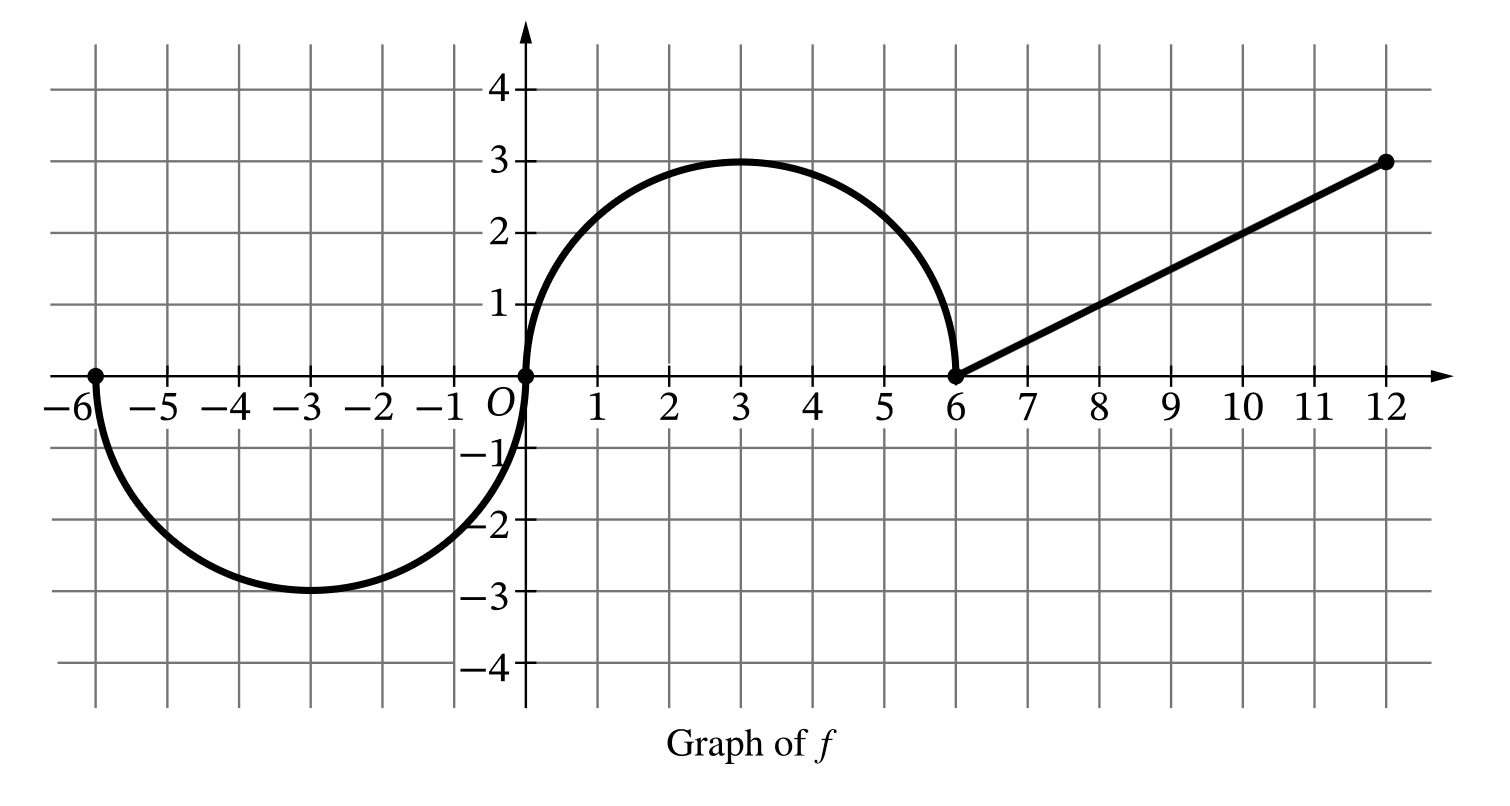
The continuous function is defined on the closed interval . The graph of , consisting of two semicircles and one line segment, is shown in the figure. Let be the function defined by .
APart A
EasyFind . Give a reason for your answer.
Need a Hint?
By the Fundamental Theorem of Calculus, if , then . Find the value of from the graph.
Show Solution
Apply FTC Part 1
Identify f(8) from the graph
From the graph, the line segment passes through and . At , .
AP Scoring Note — P1 + P2
P1 (Reason): Earned for explicitly stating or .
P2 (Answer): . Note: Simply writing without mentioning might lose the reasoning point depending on the year's stringency.
P2 (Answer): . Note: Simply writing without mentioning might lose the reasoning point depending on the year's stringency.
BPart B
MediumFind all values of in the open interval at which the graph of has a point of inflection. Give a reason for your answer.
Need a Hint?
A point of inflection for occurs when changes sign. Since , . Look for where changes from increasing to decreasing or vice versa.
Show Solution
Identify POI criteria
Inflection points of occur where changes from increasing to decreasing (relative extrema of ).
Locate points on graph
changes direction at (dec to inc), (inc to dec), and (dec to inc).
AP Scoring Note — P3 + P4
P3 (Answer): Must list all three: .
P4 (Reason): You must tie the reason to the graph of . Correct: ' changes from increasing to decreasing or vice versa'. Incorrect: 'The slope of the graph changes' (too vague).
P4 (Reason): You must tie the reason to the graph of . Correct: ' changes from increasing to decreasing or vice versa'. Incorrect: 'The slope of the graph changes' (too vague).
CPart C
MediumFind and . Label your answers.
Need a Hint?
Use geometry to find the area under the curve. Remember .
Show Solution
Calculate g(12)
.
Calculate g(0)
. The area from 0 to 6 is a semicircle with : . Therefore, .
AP Scoring Note — P5 + P6
P5 & P6 (Answers): Unlabeled values (just numbers without 'g(12)=') will earn 0 points.
You do NOT need to simplify to 9 to get the point.
You do NOT need to simplify to 9 to get the point.
DPart D
HardFind the value of at which attains an absolute minimum on . Justify your answer.
Need a Hint?
Use the Candidates Test. Check the endpoints () and critical points where .
Show Solution
Identify Candidates
Critical points (): and . Endpoints: and .
Evaluate g(x) at each candidate
.
.
.
.
.
.
.
Compare and Conclude
The smallest value is at .
AP Scoring Note — P7 + P8 + P9
P7 (Critical Points): Earned for considering where .
P8 (Justification): You must show a complete Candidates Test (table or list) or a global sign-change argument.
P9 (Answer): . Note: If you only use a local argument (First Derivative Test), you lose the justification point.
P8 (Justification): You must show a complete Candidates Test (table or list) or a global sign-change argument.
P9 (Answer): . Note: If you only use a local argument (First Derivative Test), you lose the justification point.
Question 2
2024 AP Calculus AB Exam — FRQ 4
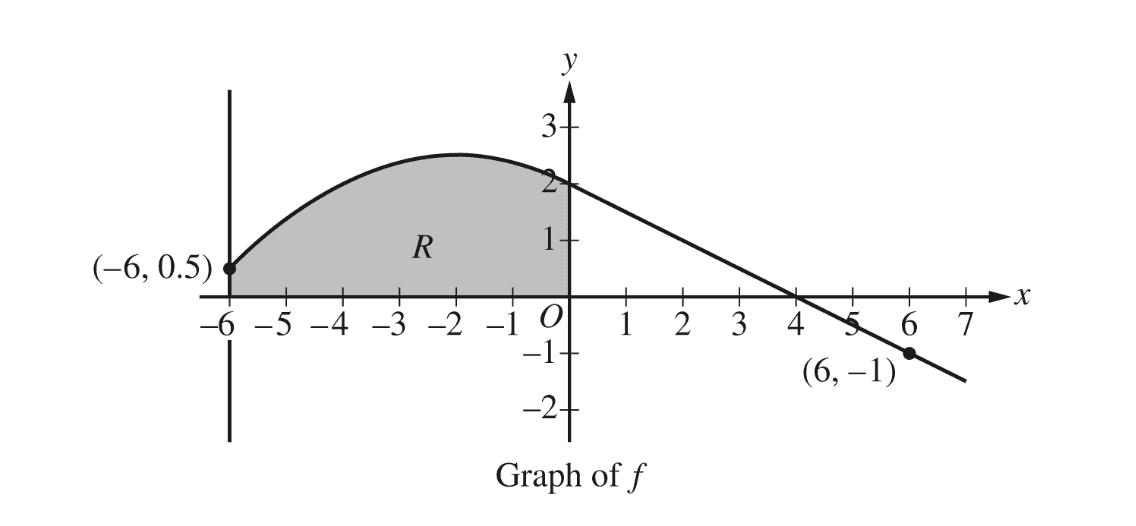
The graph of the differentiable function , shown for , has a horizontal tangent at and is linear for . Let be the region in the second quadrant bounded by the graph of , the vertical line , and the - and -axes. Region has area 12.
APart A
EasyThe function is defined by . Find the values of , , and .
Need a Hint?
Remember that . Use geometric areas for the linear parts and the given area for region R.
Show Solution
Calculate g(-6)
.
Calculate g(4)
. This is a triangle with base 4 and height 2. Area = .
Calculate g(6)
.
AP Scoring Note — P1, P2, P3
P1, P2, P3: Each correct value earns 1 point. Supporting work is not required, but if shown, it must be correct. Unlabeled values are read in order.
BPart B
EasyFor the function defined in part (a), find all values of in the interval at which the graph of has a critical point. Give a reason for your answer.
Need a Hint?
A critical point of occurs where or is undefined. Use FTC to relate to .
Show Solution
Identify Relationship
By FTC, .
Solve for Critical Points
(within the interval ).
AP Scoring Note — P4, P5
P4 (FTC): Earned for explicitly writing .
P5 (Answer+Reason): with the reason that . Reporting extra points in the interval loses this point.
P5 (Answer+Reason): with the reason that . Reporting extra points in the interval loses this point.
CPart C
MediumThe function is defined by . Find the values of , , and . Show the work that leads to your answers.
Need a Hint?
For , use FTC: . For and , differentiate and use the properties of the graph of f.
Show Solution
Calculate h(6)
.
Calculate h'(6)
. Since is linear on , is the slope of the line: . So .
Calculate h''(6)
. Since is linear on , its second derivative is . So .
AP Scoring Note — P6, P7, P8, P9
P6 (FTC): Use of .
P7 (h(6) Value): Correct calculation of .
P8 (h'(6)): Earned for stating and the value .
P9 (h''(6)): Earned for .
P7 (h(6) Value): Correct calculation of .
P8 (h'(6)): Earned for stating and the value .
P9 (h''(6)): Earned for .
Question 3
2023 AP Calculus AB Exam — FRQ 4
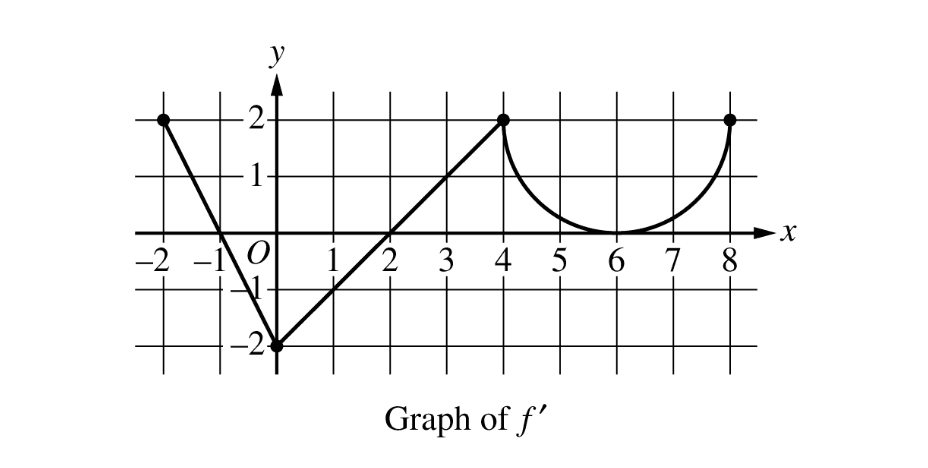
The function is defined on the closed interval and satisfies . The graph of , the derivative of , consists of two line segments and a semicircle, as shown in the figure.
APart A
EasyDoes have a relative minimum, a relative maximum, or neither at ? Give a reason for your answer.
Need a Hint?
Relative extrema occur where changes sign. Check the graph of at .
Show Solution
Analyze the sign of f'(x)
From the graph, on the interval and on the interval .
Determine Extrema
Since does not change sign at , there is neither a relative maximum nor a relative minimum at this location.
AP Scoring Note — P1
P1 (Answer w/ Reason): You must explicitly state that 'does not change sign'. Simply saying is not enough.
BPart B
MediumOn what open intervals, if any, is the graph of concave down? Give a reason for your answer.
Need a Hint?
A function is concave down when , which means is decreasing.
Show Solution
Identify where f' is decreasing
Looking at the graph, is decreasing on the intervals and .
State the reason
The graph of is concave down on and because is decreasing on these intervals.
AP Scoring Note — P2 + P3
P2 (Intervals): Earned for the correct intervals (inclusion of endpoints is okay).
P3 (Reason): You must link concavity to the behavior of (decreasing). Mentioning alone may not be enough if not tied to the given graph of .
P3 (Reason): You must link concavity to the behavior of (decreasing). Mentioning alone may not be enough if not tied to the given graph of .
CPart C
MediumFind the value of , or show that it does not exist. Justify your answer.
Need a Hint?
First check the limit of the numerator and denominator separately. If you get 0/0, apply L'Hospital's Rule.
Show Solution
Test for Indeterminate Form
Since is differentiable, it is continuous. .
.
.
Apply L'Hospital's Rule
Using L'Hospital's Rule: .
Evaluate the Limit
From the graph, .
Limit = .
Limit = .
AP Scoring Note — P4 + P5 + P6
P4 (Limits): You MUST show the limits of the numerator and denominator separately equaling 0. Writing '0/0' as an equality will lose this point.
P5 (L'Hospital's): Earned for correctly differentiating the top and bottom.
P6 (Answer): 3.
P5 (L'Hospital's): Earned for correctly differentiating the top and bottom.
P6 (Answer): 3.
DPart D
HardFind the absolute minimum value of on the closed interval . Justify your answer.
Need a Hint?
Use the Candidates Test: Check endpoints and critical points where .
Show Solution
Identify Critical Points
at .
Evaluate candidates using FTC
(Given).
.
.
.
.
.
.
Compare values
The values are . The absolute minimum is 1.
AP Scoring Note — P7 + P8 + P9
P7 (Critical Points): Earned for considering .
P8 (Justification): Must show the values or a logical elimination of endpoints/points.
P9 (Answer): The minimum value is 1. (Note: AP asks for the *value*, not just the coordinate).
P8 (Justification): Must show the values or a logical elimination of endpoints/points.
P9 (Answer): The minimum value is 1. (Note: AP asks for the *value*, not just the coordinate).
Timed Practice
Ready to challenge yourself?
Take a 20-minute timed mock exam to test your understanding.
Common Pitfalls
- ⚠The 'Going Backwards' Integration ErrorWhen calculating given , you need . Since the limits are upper-to-lower (), you must subtract the area under the graph. Students often forget to flip the sign.
- ⚠Misidentifying Points of Inflection (POI)A POI occurs where changes sign, which means where the graph of changes from increasing to decreasing (a relative extremum on the graph). Simply is not enough.
- ⚠Vague Justifications (The 'It' Trap)Avoid using the word 'it' (e.g., 'It is increasing'). AP readers will not give credit. Specify the function: ' is positive,' or 'The slope of is negative.'
- ⚠Forgetting the Initial Value in FTCJust like in Particle Motion, finding is not just the area from 0 to 5. It is . If you forget , you lose the 'Answer' point.
- ⚠Confusing 's Value with 's SlopeRemember: The y-value of the graph is (determines increase/decrease). The slope of the graph is (determines concavity).

Gary Chang
Calculus Educator5+ Years of Calculus Teaching Experience | AP Calculus Specialist. Dedicated to helping students master calculus through step-by-step logic and clear visualizations.