← All Exam Answers

2022 AP Calculus AB Free-Response Questions — Full Solutions

Complete worked solutions with scoring breakdowns for all 6 FRQs

6 Questions24 Parts TotalFull Solutions Included

Questions 1–2 (Part A, 30 min) permit a graphing calculator. Questions 3–6 (Part B, 60 min) do not.

Question 1

Calculator OK

Toll Plaza Arrival Rate

Rate, Average Value & Optimization

Open this question on its own page
Hard
From 5 A.M. to 10 A.M., the rate at which vehicles arrive at a certain toll plaza is given by A(t)=450sin⁡(0.62t)A(t) = 450\sqrt{\sin(0.62t)}, where tt is the number of hours after 5 A.M. and A(t)A(t) is measured in vehicles per hour. Traffic is flowing smoothly at 5 A.M. with no vehicles waiting in line.
Part AEasy1 point
Write, but do not evaluate, an integral expression that gives the total number of vehicles that arrive at the toll plaza from 6 A.M. (t=1t=1) to 10 A.M. (t=5t=5).

Answer

∫15A(t) dt=∫15450sin⁡(0.62t) dt\displaystyle\int_1^5 A(t)\,dt = \int_1^5 450\sqrt{\sin(0.62t)}\,dt
Full Solution & Work

Set up the accumulation integral

Total vehicles = accumulated arrival rate over the interval:
∫15A(t) dt=∫15450sin⁡(0.62t) dt\int_1^5 A(t)\,dt = \int_1^5 450\sqrt{\sin(0.62t)}\,dt

AP Scoring — 1 Point

**P1**: Correct integrand A(t)A(t) with correct limits t=1t=1 to t=5t=5.
Part BMedium2 points
Find the average value of the rate, in vehicles per hour, at which vehicles arrive at the toll plaza from 6 A.M. (t=1t=1) to 10 A.M. (t=5t=5).

Answer

≈ 375.537 vehicles per hour
Full Solution & Work

Apply the average value formula

15−1∫15A(t) dt\frac{1}{5-1}\int_1^5 A(t)\,dt

Evaluate with a calculator

≈375.537 vehicles per hour\approx 375.537 \text{ vehicles per hour}

AP Scoring — 2 Points

**P1**: Correct average-value setup 14∫15A(t) dt\frac14\int_1^5 A(t)\,dt.
**P2**: Correct answer, 375.537 (accept 375.536–375.538).
Part CMedium2 points
Is the rate at which vehicles arrive at the toll plaza at 6 A.M. (t=1t=1) increasing or decreasing? Give a reason for your answer.

Answer

Increasing, because A′(1)≈148.947>0A'(1)\approx148.947>0.
Full Solution & Work

Differentiate A(t)

A′(t)=450⋅12(sin⁡(0.62t))−1/2⋅0.62cos⁡(0.62t)=139.5cos⁡(0.62t)sin⁡(0.62t)A'(t) = 450\cdot\frac12\big(\sin(0.62t)\big)^{-1/2}\cdot0.62\cos(0.62t) = \frac{139.5\cos(0.62t)}{\sqrt{\sin(0.62t)}}

Evaluate at t = 1

A′(1)≈148.947>0A'(1) \approx 148.947 > 0

Conclude

Since A′(1)>0A'(1)>0, the rate at which vehicles arrive is **increasing** at t=1t=1.

AP Scoring — 2 Points

**P1**: A correct expression or numerical value for A′(1)A'(1).
**P2**: Correct conclusion ("increasing") tied to the sign of
A′(1)A'(1).
Part DHard4 points
A line forms whenever A(t)≥400A(t)\geq400. The number of vehicles in line at time tt, for a≤t≤4a\leq t\leq4, is given by N(t)=∫at(A(x)−400) dxN(t)=\displaystyle\int_a^t (A(x)-400)\,dx, where aa is the time when a line first begins to form. To the nearest whole number, find the greatest number of vehicles in line at the toll plaza in the time interval a≤t≤4a\leq t\leq4. Justify your answer.

Answer

≈ 71 vehicles
Full Solution & Work

Find a, the time the line first forms

aa is the first positive solution to A(t)=400A(t)=400:
450sin⁡(0.62t)=400  ⟹  t=a≈1.469450\sqrt{\sin(0.62t)}=400 \implies t = a \approx 1.469

Find where N could be maximized

N′(t)=A(t)−400N'(t)=A(t)-400. Since AA rises above 400 at t=at=a and later falls back below 400 at a second crossing, t≈3.598t\approx3.598 (within [a,4][a,4]), N′(t)>0N'(t)>0 on (a,3.598)(a,3.598) and N′(t)<0N'(t)<0 on (3.598,4)(3.598,4). So NN is maximized at t≈3.598t\approx3.598.

Evaluate N at the maximizing time

N(3.598)=∫a3.598(A(x)−400) dx≈71.254N(3.598) = \int_a^{3.598}\big(A(x)-400\big)\,dx \approx 71.254

(compare to
N(4)≈62.338N(4)\approx62.338, confirming the interior critical point gives the larger value)

Conclude

To the nearest whole number, the greatest number of vehicles in line is **71**.

AP Scoring — 4 Points

**P1**: Correctly finds a≈1.469a\approx1.469, the first time A(t)=400A(t)=400.
**P2**: Considers
N′(t)=A(t)−400=0N'(t)=A(t)-400=0, i.e. the second crossing t≈3.598t\approx3.598, as the critical point of interest.
**P3**: A justification comparing
NN at the critical point to N(4)N(4) (global argument), or a sign analysis of N′N' around t≈3.598t\approx3.598.
**P4**: Correct final answer, 71 vehicles, with supporting work.

Common mistake: A common shortcut error: forgetting that the domain is restricted to $[a,4]$ and instead searching for a maximum over the full $[0,5]$ range covered by $A(t)$ — the question only asks about the line's length up to $t=4$.

Study the concept

Learn the theory behind this question type with worked examples and strategy tips.

Practice More

Question 2

Calculator OK

Area and Volume Between f and g

Area & Volume

Open this question on its own page
Hard
Let ff and gg be the functions defined by f(x)=ln⁡(x+3)f(x)=\ln(x+3) and g(x)=x4+2x3g(x)=x^4+2x^3. The graphs of ff and gg intersect at x=−2x=-2 and x=Bx=B, where B>0B>0.
Part AMedium2 points
Find the area of the region enclosed by the graphs of ff and gg.

Answer

≈ 3.604
Full Solution & Work

Find B

Solving f(x)=g(x)f(x)=g(x) numerically for the positive root: B≈0.782B\approx0.782.

Set up and evaluate the area integral

On [−2,B][-2,B], f(x)≥g(x)f(x)\geq g(x) (confirmed by checking f−g>0f-g>0 at interior points):
Area=∫−2B(f(x)−g(x)) dx≈3.604\text{Area}=\int_{-2}^{B}\big(f(x)-g(x)\big)\,dx \approx 3.604

AP Scoring — 2 Points

**P1**: Correct integrand f(x)−g(x)f(x)-g(x) (or equivalent) with correct limits −2-2 to BB.
**P2**: Correct answer, 3.604 (accept 3.603–3.605).
Part BMedium2 points
For −2≤x≤B-2\leq x\leq B, let h(x)h(x) be the vertical distance between the graphs of ff and gg. Is hh increasing or decreasing at x=−0.5x=-0.5? Give a reason for your answer.

Answer

Decreasing, since h′(−0.5)=−0.6<0h'(-0.5)=-0.6<0.
Full Solution & Work

Write h(x) and differentiate

Since f≥gf\geq g on this interval, h(x)=f(x)−g(x)=ln⁡(x+3)−x4−2x3h(x)=f(x)-g(x)=\ln(x+3)-x^4-2x^3.
h′(x)=1x+3−4x3−6x2h'(x) = \frac{1}{x+3}-4x^3-6x^2

Evaluate at x = -0.5

h′(−0.5)=12.5−4(−0.125)−6(0.25)=0.4+0.5−1.5=−0.6h'(-0.5) = \frac{1}{2.5}-4(-0.125)-6(0.25) = 0.4+0.5-1.5 = -0.6

Conclude

Since h′(−0.5)=−0.6<0h'(-0.5)=-0.6<0, hh is **decreasing** at x=−0.5x=-0.5.

AP Scoring — 2 Points

**P1**: Correct expression for h′(x)h'(x) or a correctly-evaluated h′(−0.5)h'(-0.5).
**P2**: Correct conclusion ("decreasing") tied to the sign of
h′(−0.5)h'(-0.5).
Part CHard3 points
The region enclosed by the graphs of ff and gg is the base of a solid. Cross sections of the solid taken perpendicular to the xx-axis are squares. Find the volume of the solid.

Answer

≈ 5.340
Full Solution & Work

Set up the volume integral

Each square cross section has side length h(x)=f(x)−g(x)h(x)=f(x)-g(x), so area (h(x))2\big(h(x)\big)^2:
V=∫−2B(f(x)−g(x))2 dxV = \int_{-2}^{B} \big(f(x)-g(x)\big)^2\,dx

Evaluate with a calculator

V≈5.340V \approx 5.340

AP Scoring — 3 Points

**P1**: Integrand of the form (f(x)−g(x))2(f(x)-g(x))^2.
**P2**: Correct limits
−2-2 to BB.
**P3**: Correct answer, 5.340 (accept 5.339–5.341).
Part DHard2 points
A vertical line in the xyxy-plane travels from left to right along the base of the solid described in part (c). The vertical line is moving at a constant rate of 7 units per second. Find the rate of change of the area of the cross section above the vertical line with respect to time when the vertical line is at position x=−0.5x=-0.5.

Answer

≈ −9.272 (square units per second)
Full Solution & Work

Write the cross-sectional area as a function of x, then apply the chain rule

Across(x)=(h(x))2  ⟹  dAcrossdt=2h(x)⋅h′(x)⋅dxdtA_{\text{cross}}(x) = \big(h(x)\big)^2 \implies \frac{dA_{\text{cross}}}{dt} = 2h(x)\cdot h'(x)\cdot\frac{dx}{dt}

Substitute values at x = -0.5

From parts (b): h(−0.5)≈1.104h(-0.5)\approx1.104, h′(−0.5)=−0.6h'(-0.5)=-0.6. Given dxdt=7\frac{dx}{dt}=7:
dAcrossdt=2(1.104)(−0.6)(7)≈−9.272\frac{dA_{\text{cross}}}{dt} = 2(1.104)(-0.6)(7) \approx -9.272

AP Scoring — 2 Points

**P1**: Correct related-rates setup dAcrossdt=2h(x)h′(x)dxdt\frac{dA_{\text{cross}}}{dt}=2h(x)h'(x)\frac{dx}{dt}.
**P2**: Correct answer,
−9.272-9.272 (accept −9.270-9.270 to −9.274-9.274).

Study the concept

Learn the theory behind this question type with worked examples and strategy tips.

Practice More

Question 3

No Calculator

Analyzing a Function from its Derivative Graph

Graph Analysis & Curve Sketching

Open this question on its own page
Hard
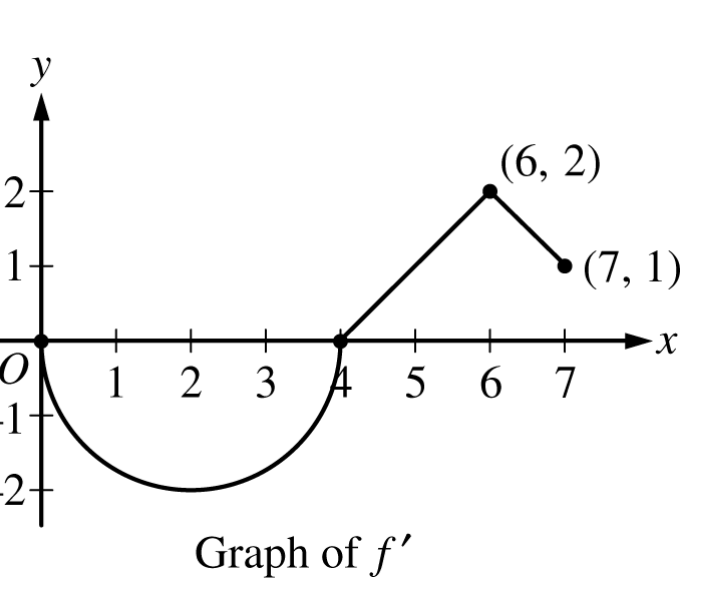
Let ff be a differentiable function with f(4)=3f(4)=3. On the interval 0≤x≤70\leq x\leq7, the graph of f′f', the derivative of ff, consists of a semicircle (radius 2, centered at (2,0)(2,0), dipping below the axis) and two line segments: from (4,0)(4,0) to (6,2)(6,2), and from (6,2)(6,2) to (7,1)(7,1).
2022 AP Calculus AB FRQ Question 3 Graph of f'
Graph of $f'$ on $[0,7]$.
Part AMedium2 points
Find f(0)f(0) and f(5)f(5).

Answer

f(0)=3+2πf(0) = 3+2\pi; f(5)=3.5f(5)=3.5
Full Solution & Work

Find f(0) using the semicircle's signed area

f(0)=f(4)−∫04f′(x) dx=3−(−12π(2)2)=3+2πf(0) = f(4) - \int_0^4 f'(x)\,dx = 3 - \left(-\frac12\pi(2)^2\right) = 3+2\pi

Find f(5) using the triangle's area

f(5)=f(4)+∫45f′(x) dx=3+12(1)(1)=3.5f(5) = f(4)+\int_4^5 f'(x)\,dx = 3+\frac12(1)(1) = 3.5

AP Scoring — 2 Points

**P1**: f(0)=3+2πf(0)=3+2\pi.
**P2**:
f(5)=3.5f(5)=3.5.
Part BHard2 points
Find the xx-coordinates of all points of inflection of the graph of ff for 0<x<70<x<7. Justify your answer.

Answer

x=2x=2 and x=6x=6
Full Solution & Work

Relate inflection points to local extrema of f'

ff has a point of inflection where f′′=(f′)′f''=(f')' changes sign — i.e., where f′f' has a local min or max.

Locate local extrema of f'

f′f' has a local minimum at x=2x=2 (bottom of the semicircle) and a local maximum at x=6x=6 (peak of the "tent" formed by the two line segments).

Conclude

So ff has points of inflection at x=2x=2 and x=6x=6 (at x=4x=4, f′f' keeps increasing through the corner, so there's no sign change and no inflection point there).

AP Scoring — 2 Points

**P1**: Correct values x=2x=2 and x=6x=6 (no additional/incorrect values).
**P2**: Justification tied to
f′f' having a local extremum (or f′′f'' changing sign) at each location.
Part CHard3 points
Let gg be the function defined by g(x)=f(x)−xg(x)=f(x)-x. On what intervals, if any, is gg decreasing for 0≤x≤70\leq x\leq7? Show the analysis that leads to your answer.

Answer

(0,5)(0,5)
Full Solution & Work

Set up g'(x) = f'(x) - 1

gg is decreasing where g′(x)=f′(x)−1<0g'(x)=f'(x)-1<0, i.e. where f′(x)<1f'(x)<1.

Compare f'(x) to 1 on each piece

On [0,4][0,4] (the semicircle): f′(x)≤0<1f'(x)\leq0<1 throughout.
On
[4,6][4,6] (line, slope 1, from (4,0)(4,0) to (6,2)(6,2)): f′(x)=x−4<1f'(x)=x-4<1 for x<5x<5.
On
[6,7][6,7] (line from (6,2)(6,2) to (7,1)(7,1)): f′(x)=8−x≥1f'(x)=8-x\geq1 throughout, so f′≥1f'\geq1 here.

Conclude

f′(x)<1f'(x)<1 (so gg is decreasing) precisely on (0,5)(0,5).

AP Scoring — 3 Points

**P1**: Setting up g′(x)=f′(x)−1g'(x)=f'(x)-1.
**P2**: Correctly comparing
f′(x)f'(x) to 1 on each piece of the domain.
**P3**: Correct interval,
(0,5)(0,5), with supporting analysis.
Part DHard2 points
For the function gg defined in part (c), find the absolute minimum value on the interval 0≤x≤70\leq x\leq7. Justify your answer.

Answer

−1.5-1.5, at x=5x=5
Full Solution & Work

Identify the critical point

From part (c), gg decreases on (0,5)(0,5) and increases on (5,7)(5,7) (since f′(x)≥1f'(x)\geq1 throughout (5,7)(5,7)), so x=5x=5 is the location of the global minimum on [0,7][0,7].

Evaluate g(5)

g(5)=f(5)−5=3.5−5=−1.5g(5) = f(5)-5 = 3.5-5=-1.5

Confirm against the endpoints

g(0)=f(0)−0=3+2π≈9.283g(0)=f(0)-0=3+2\pi\approx9.283 and g(7)=f(7)−7g(7)=f(7)-7, where f(7)=f(6)+∫67f′(x) dx=5+1.5=6.5f(7)=f(6)+\int_6^7f'(x)\,dx=5+1.5=6.5, so g(7)=−0.5g(7)=-0.5. Both exceed −1.5-1.5, confirming the minimum is at x=5x=5.

AP Scoring — 2 Points

**P1**: Correctly identifies x=5x=5 as the global minimum location, with justification (sign change of g′g' from negative to positive).
**P2**: Correct value,
g(5)=−1.5g(5)=-1.5.

Study the concept

Learn the theory behind this question type with worked examples and strategy tips.

Practice More

Question 4

No Calculator

Melting Ice Sculpture — Table Data

Rate & Data from Tables

Open this question on its own page
Hard
An ice sculpture melts in such a way that it can be modeled as a cone that maintains a conical shape as it decreases in size. The radius of the base of the cone is given by a twice-differentiable function rr, where r(t)r(t) is measured in centimeters and tt is measured in days. The table above gives selected values of r′(t)r'(t), the rate of change of the radius, over the time interval 0≤t≤120\leq t\leq12.

Values of r′(t)

t (days)0371012
r′(t) (centimeters per day)−6.1−5.0−4.4−3.8−3.5
Part AEasy2 points
Approximate r′′(8.5)r''(8.5) using the average rate of change of r′r' over the interval 7≤t≤107\leq t\leq10. Show the computations that lead to your answer, and indicate units of measure.

Answer

r′′(8.5)≈0.2r''(8.5)\approx0.2 cm/day²
Full Solution & Work

Set up the difference quotient

r′′(8.5)≈r′(10)−r′(7)10−7=−3.8−(−4.4)3=0.63=0.2r''(8.5) \approx \frac{r'(10)-r'(7)}{10-7} = \frac{-3.8-(-4.4)}{3} = \frac{0.6}{3}=0.2

State the units

The units are centimeters per day per day (cm/day²).

AP Scoring — 2 Points

**P1**: The difference quotient, correctly set up and evaluated.
**P2**: Correct units.
Part BMedium2 points
Is there a time tt, 0≤t≤30\leq t\leq3, for which r′(t)=−6r'(t)=-6? Justify your answer.

Answer

Yes, by the Intermediate Value Theorem.
Full Solution & Work

Set up the IVT argument

rr is twice-differentiable, so r′r' is differentiable, hence continuous, on [0,3][0,3].

Compare -6 to the endpoint values

r′(0)=−6.1<−6<−5.0=r′(3)r'(0)=-6.1<-6<-5.0=r'(3)

Conclude

By the **Intermediate Value Theorem**, since r′r' is continuous on [0,3][0,3] and −6-6 lies between r′(0)r'(0) and r′(3)r'(3), there must exist a t∈(0,3)t\in(0,3) with r′(t)=−6r'(t)=-6.

AP Scoring — 2 Points

**P1**: Establishes continuity of r′r' on [0,3][0,3].
**P2**: Correct comparison and conclusion citing the IVT.
Part CMedium2 points
Use a right Riemann sum with the four subintervals indicated in the table to approximate the value of ∫012r′(t) dt\displaystyle\int_0^{12} r'(t)\,dt.

Answer

−51-51
Full Solution & Work

Set up the right Riemann sum

∫012r′(t) dt≈3⋅r′(3)+4⋅r′(7)+3⋅r′(10)+2⋅r′(12)\int_0^{12} r'(t)\,dt \approx 3\cdot r'(3)+4\cdot r'(7)+3\cdot r'(10)+2\cdot r'(12)

Substitute and compute

=3(−5.0)+4(−4.4)+3(−3.8)+2(−3.5)=−15−17.6−11.4−7=−51= 3(-5.0)+4(-4.4)+3(-3.8)+2(-3.5) = -15-17.6-11.4-7=-51

AP Scoring — 2 Points

**P1**: Correct form of the right Riemann sum with correct widths.
**P2**: Correct answer,
−51-51.
Part DHard3 points
The height of the cone decreases at a rate of 2 centimeters per day. At time t=3t=3 days, the radius is 100 centimeters and the height is 50 centimeters. Find the rate of change of the volume of the cone with respect to time, in cubic centimeters per day, at time t=3t=3 days. (The volume VV of a cone with radius rr and height hh is V=13πr2hV=\dfrac13\pi r^2 h.)

Answer

−70000π3≈−73303.83-\dfrac{70000\pi}{3}\approx -73303.83 cm³/day
Full Solution & Work

Differentiate V with respect to t

dVdt=13π(2rdrdth+r2dhdt)\frac{dV}{dt} = \frac{1}{3}\pi\left(2r\frac{dr}{dt}h+r^2\frac{dh}{dt}\right)

Substitute values at t = 3

r=100r=100, drdt=r′(3)=−5\frac{dr}{dt}=r'(3)=-5 (from the table), h=50h=50, dhdt=−2\frac{dh}{dt}=-2:
dVdt=π3[2(100)(−5)(50)+(100)2(−2)]=π3[−50000−20000]\frac{dV}{dt} = \frac{\pi}{3}\Big[2(100)(-5)(50)+(100)^2(-2)\Big] = \frac{\pi}{3}\big[-50000-20000\big]

Simplify

=π3(−70000)=−70000π3≈−73303.83 cm3/day= \frac{\pi}{3}(-70000) = -\frac{70000\pi}{3} \approx -73303.83 \text{ cm}^3/\text{day}

AP Scoring — 3 Points

**P1**: Correct related-rates differentiation of V=13πr2hV=\frac13\pi r^2 h using the Product Rule.
**P2**: Correct substitution, including using the table value
r′(3)=−5r'(3)=-5 for drdt\frac{dr}{dt}.
**P3**: Correct final answer,
−70000π3-\frac{70000\pi}{3} (or its decimal equivalent).

Study the concept

Learn the theory behind this question type with worked examples and strategy tips.

Practice More

Question 5

No Calculator

A Differential Equation with a Square-Root Factor

Differential Equations

Open this question on its own page
Hard
Consider the differential equation dydx=12sin⁡ ⁣(π2x)y+7\dfrac{dy}{dx}=\dfrac{1}{2}\sin\!\left(\dfrac{\pi}{2}x\right)\sqrt{y+7}. Let y=f(x)y=f(x) be the particular solution to the differential equation with the initial condition f(1)=2f(1)=2. The function ff is defined for all real numbers.
Part AEasy1 point
A portion of the slope field for the differential equation is given. Sketch the solution curve through the point (1,2)(1,2).

Answer

The curve rises through (1,2)(1,2), following the slope field.
Full Solution & Work

Follow the slope field from (1, 2)

At (1,2)(1,2): dydx=12sin⁡(π/2)9=12(1)(3)=1.5\frac{dy}{dx}=\frac12\sin(\pi/2)\sqrt9=\frac12(1)(3)=1.5, a fairly steep positive slope. Following the field, the curve continues rising to the right and falls off to the left of x=1x=1, consistent with the shown slope field.

AP Scoring — 1 Point

**P1**: The solution curve must pass through (1,2)(1,2) and have no obvious conflicts with the given slope lines.
Part BMedium2 points
Write an equation for the line tangent to the solution curve in part (a) at the point (1,2)(1,2). Use the equation to approximate f(0.8)f(0.8).

Answer

y=2+1.5(x−1)y=2+1.5(x-1); f(0.8)≈1.7f(0.8)\approx1.7
Full Solution & Work

Find the slope at (1,2)

dydx∣(1,2)=12sin⁡ ⁣(π2)2+7=12(1)(3)=1.5\left.\frac{dy}{dx}\right|_{(1,2)} = \frac12\sin\!\left(\frac{\pi}{2}\right)\sqrt{2+7} = \frac12(1)(3)=1.5

Write the tangent line and approximate

y=2+1.5(x−1)y=2+1.5(x-1)

f(0.8)≈2+1.5(0.8−1)=2−0.3=1.7f(0.8) \approx 2+1.5(0.8-1)=2-0.3=1.7

AP Scoring — 2 Points

**P1**: Correct slope, 1.5, at (1,2)(1,2).
**P2**: Correct approximation,
f(0.8)≈1.7f(0.8)\approx1.7.
Part CMedium1 point
It is known that f′′(x)>0f''(x)>0 for −1≤x≤1-1\leq x\leq1. Is the approximation found in part (b) an overestimate or an underestimate for f(0.8)f(0.8)? Give a reason for your answer.

Answer

Underestimate.
Full Solution & Work

Relate concavity to tangent-line approximation

Since f′′(x)>0f''(x)>0 on [−1,1][-1,1], the graph of ff is **concave up** there, so the tangent line lies **below** the curve on this interval.

Conclude

Since 0.8∈[−1,1]0.8\in[-1,1], the tangent-line approximation f(0.8)≈1.7f(0.8)\approx1.7 is an **underestimate** of the actual value.

AP Scoring — 1 Point

**P1**: "Underestimate," with reasoning tied to f′′(x)>0f''(x)>0 (concave up).
Part DHard3 points
Use separation of variables to find y=f(x)y=f(x), the particular solution to the differential equation dydx=12sin⁡ ⁣(π2x)y+7\dfrac{dy}{dx}=\dfrac12\sin\!\left(\dfrac{\pi}{2}x\right)\sqrt{y+7} with the initial condition f(1)=2f(1)=2.

Answer

y=[3−12πcos⁡ ⁣(π2x)]2−7y = \left[3-\dfrac{1}{2\pi}\cos\!\left(\dfrac{\pi}{2}x\right)\right]^2-7
Full Solution & Work

Separate variables

dyy+7=12sin⁡ ⁣(π2x)dx\frac{dy}{\sqrt{y+7}} = \frac12\sin\!\left(\frac{\pi}{2}x\right)dx

Integrate both sides

2y+7=−1πcos⁡ ⁣(π2x)+C2\sqrt{y+7} = -\frac{1}{\pi}\cos\!\left(\frac{\pi}{2}x\right)+C

Apply the initial condition f(1) = 2

At x=1,y=2x=1,y=2: 29=6=−1πcos⁡(π/2)+C=0+C  ⟹  C=62\sqrt9=6=-\frac1\pi\cos(\pi/2)+C=0+C \implies C=6.
2y+7=6−1πcos⁡ ⁣(π2x)2\sqrt{y+7} = 6-\frac{1}{\pi}\cos\!\left(\frac\pi2 x\right)

Solve for y

y+7=3−12πcos⁡ ⁣(π2x)\sqrt{y+7} = 3-\frac{1}{2\pi}\cos\!\left(\frac\pi2 x\right)

y=[3−12πcos⁡ ⁣(π2x)]2−7y = \left[3-\frac{1}{2\pi}\cos\!\left(\frac\pi2 x\right)\right]^2-7

AP Scoring — 3 Points

**P1**: Correct separation of variables.
**P2**: Correct antiderivatives on both sides, with constant of integration correctly evaluated using
f(1)=2f(1)=2.
**P3**: Correctly solves for
yy to reach the final closed form.

Study the concept

Learn the theory behind this question type with worked examples and strategy tips.

Practice More

Question 6

No Calculator

Two Particles in Motion

Particle Motion

Open this question on its own page
Hard
Particle PP moves along the xx-axis such that, for time t>0t>0, its position is given by xP(t)=6−4e−tx_P(t)=6-4e^{-t}. Particle QQ moves along the yy-axis such that, for time t>0t>0, its velocity is given by vQ(t)=1t2v_Q(t)=\dfrac{1}{t^2}. At time t=1t=1, the position of particle QQ is yQ(1)=2y_Q(1)=2.
Part AEasy1 point
Find vP(t)v_P(t), the velocity of particle PP at time tt.

Answer

vP(t)=4e−tv_P(t)=4e^{-t}
Full Solution & Work

Differentiate x_P(t)

vP(t)=xP′(t)=−4(−e−t)=4e−tv_P(t) = x_P'(t) = -4(-e^{-t}) = 4e^{-t}

AP Scoring — 1 Point

**P1**: Correct answer, vP(t)=4e−tv_P(t)=4e^{-t}.
Part BHard3 points
Find aQ(t)a_Q(t), the acceleration of particle QQ at time tt. Find all times tt, for t>0t>0, when the speed of particle QQ is decreasing. Justify your answer.

Answer

aQ(t)=−2t3a_Q(t)=-\dfrac{2}{t^3}; speed is decreasing for all t>0t>0.
Full Solution & Work

Differentiate v_Q(t)

aQ(t)=vQ′(t)=−2t3a_Q(t) = v_Q'(t) = -\frac{2}{t^3}

Compare signs of v_Q and a_Q for t > 0

vQ(t)=1t2>0v_Q(t)=\frac{1}{t^2}>0 for all t>0t>0. aQ(t)=−2t3<0a_Q(t)=-\frac{2}{t^3}<0 for all t>0t>0. So vQv_Q and aQa_Q have **opposite signs** for every t>0t>0.

Conclude

The speed of particle QQ is **decreasing for all t>0t>0** — the particle continually slows as it moves.

AP Scoring — 3 Points

**P1**: Correct aQ(t)=−2t3a_Q(t)=-\frac{2}{t^3}.
**P2**: Correct sign analysis showing
vQ(t)v_Q(t) and aQ(t)a_Q(t) have opposite signs.
**P3**: Correct conclusion — for **all**
t>0t>0, with justification.
Part CMedium2 points
Find yQ(t)y_Q(t), the position of particle QQ at time tt.

Answer

yQ(t)=3−1ty_Q(t)=3-\dfrac{1}{t}
Full Solution & Work

Set up position as initial position plus accumulated change

yQ(t)=yQ(1)+∫1tvQ(s) ds=2+∫1ts−2 dsy_Q(t) = y_Q(1)+\int_1^t v_Q(s)\,ds = 2+\int_1^t s^{-2}\,ds

Evaluate the integral

=2+[−s−1]1t=2+(−1t+1)=3−1t= 2+\left[-s^{-1}\right]_1^t = 2+\left(-\frac1t+1\right) = 3-\frac1t

AP Scoring — 2 Points

**P1**: Correct setup yQ(1)+∫1tvQ(s) dsy_Q(1)+\int_1^t v_Q(s)\,ds.
**P2**: Correct final answer,
yQ(t)=3−1ty_Q(t)=3-\frac1t.
Part DMedium2 points
As t→∞t\to\infty, which particle will eventually be farther from the origin? Give a reason for your answer.

Answer

Particle P.
Full Solution & Work

Find the limiting positions

lim⁡t→∞xP(t)=lim⁡t→∞(6−4e−t)=6,lim⁡t→∞yQ(t)=lim⁡t→∞(3−1t)=3\lim_{t\to\infty} x_P(t) = \lim_{t\to\infty}\big(6-4e^{-t}\big) = 6, \qquad \lim_{t\to\infty} y_Q(t) = \lim_{t\to\infty}\left(3-\frac1t\right)=3

Compare

Both xP(t)x_P(t) and yQ(t)y_Q(t) increase monotonically toward their respective limits, staying below them for all finite tt. Since lim⁡xP=6>lim⁡yQ=3\lim x_P = 6 > \lim y_Q=3, particle PP's distance from the origin approaches a strictly larger value.

Conclude

As t→∞t\to\infty, particle **PP** will eventually be farther from the origin.

AP Scoring — 2 Points

**P1**: Correctly computes both limits, 6 and 3.
**P2**: Correct conclusion (particle
PP) with a reason comparing the two limits.

Study the concept

Learn the theory behind this question type with worked examples and strategy tips.

Practice More
Gary Chang

Gary Chang

Calculus Educator

5+ Years of Calculus Teaching Experience | AP Calculus Specialist. Dedicated to helping students master calculus through step-by-step logic and clear visualizations.

Finished reviewing?

Keep your momentum going