2021 AP Calculus AB FRQ Question 4: Graph Analysis with an Accumulation Function
Full worked solution for every part, with AP scoring notes. See all 6 questions from 2021.
Question 4
No CalculatorGraph Analysis with an Accumulation Function
Graph Analysis & Curve Sketching
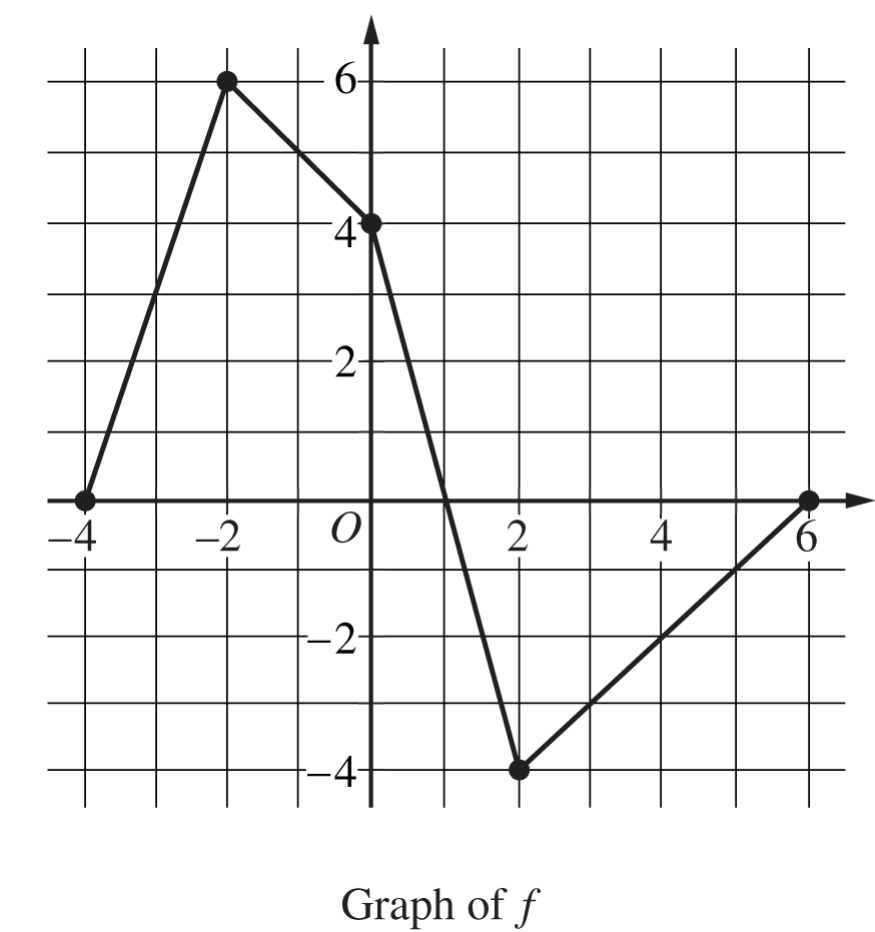
Let be a continuous function defined on the closed interval . The graph of , consisting of four line segments connecting , , , , and , is shown. Let be the function defined by .
Part AMedium2 points
On what open intervals is the graph of concave up? Give a reason for your answer.
Answer
and
Full Solution & Work
Relate concavity of G to the slope of f
, so equals the (constant) slope of on each line segment. is concave up where , i.e. where has positive slope.
Compute each segment's slope
: slope .
: slope .
: slope .
: slope .
: slope .
: slope .
: slope .
Conclude
is concave up where the slope of is positive: on ** and **.
AP Scoring — 2 Points
**P1**: Correctly relates to the slopes of the line segments.
**P2**: Correct intervals, and .
**P2**: Correct intervals, and .
Part BHard3 points
Let be the function defined by . Find .
Answer
Full Solution & Work
Apply the Product Rule
Find f(3) and f'(3)
On , . So , and (the segment's constant slope).
Find G(3)
Combine
AP Scoring — 3 Points
**P1**: Correct Product Rule setup, .
**P2**: Correctly finds , , and .
**P3**: Correct final answer, 1.375.
**P2**: Correctly finds , , and .
**P3**: Correct final answer, 1.375.
Part CHard2 points
Find .
Answer
Full Solution & Work
Confirm the indeterminate form
(computed in part (b)), and as . This is , so L'Hôpital's Rule applies.
Apply L'Hôpital's Rule
Evaluate
(continuous at the shared endpoint of the two segments), and :
AP Scoring — 2 Points
**P1**: Confirms the form and applies L'Hôpital's Rule (or an equivalent factoring approach).
**P2**: Correct final answer, .
**P2**: Correct final answer, .
Part DMedium2 points
Find the average rate of change of on the interval . Does the Mean Value Theorem guarantee a value , , for which is equal to this average rate of change? Justify your answer.
Answer
Average rate of change ; yes, the MVT applies.
Full Solution & Work
Find G(-4) and G(2)
(from part b). , and , so .
Compute the average rate of change
Check the hypotheses of the MVT
with continuous everywhere on , so is differentiable (with ) — and hence continuous — on all of .
Conclude
Since is differentiable on and continuous on , the **Mean Value Theorem** guarantees a with .
AP Scoring — 2 Points
**P1**: Correctly computes the average rate of change, .
**P2**: Correct "yes" with justification citing differentiability of (via continuity of ).
**P2**: Correct "yes" with justification citing differentiability of (via continuity of ).
Study the concept
Learn the theory behind this question type with worked examples and strategy tips.

Gary Chang
Calculus Educator5+ Years of Calculus Teaching Experience | AP Calculus Specialist. Dedicated to helping students master calculus through step-by-step logic and clear visualizations.
Finished reviewing?
Keep your momentum going
Practice multiple choice80 AP-style MCQs with full explanations, or a timed 45-question exam.Estimate your AP scorePlug in your MCQ and FRQ points to see your likely 1–5.Follow the 30-day planA day-by-day review of every AP Calc AB unit, from limits to volume.Practice FRQ by topicMaster each question type before the next exam.