2023 AP Calculus AB FRQ Question 4: Analyzing a Function from its Derivative Graph
Full worked solution for every part, with AP scoring notes. See all 6 questions from 2023.
Question 4
No CalculatorAnalyzing a Function from its Derivative Graph
Graph Analysis & Curve Sketching
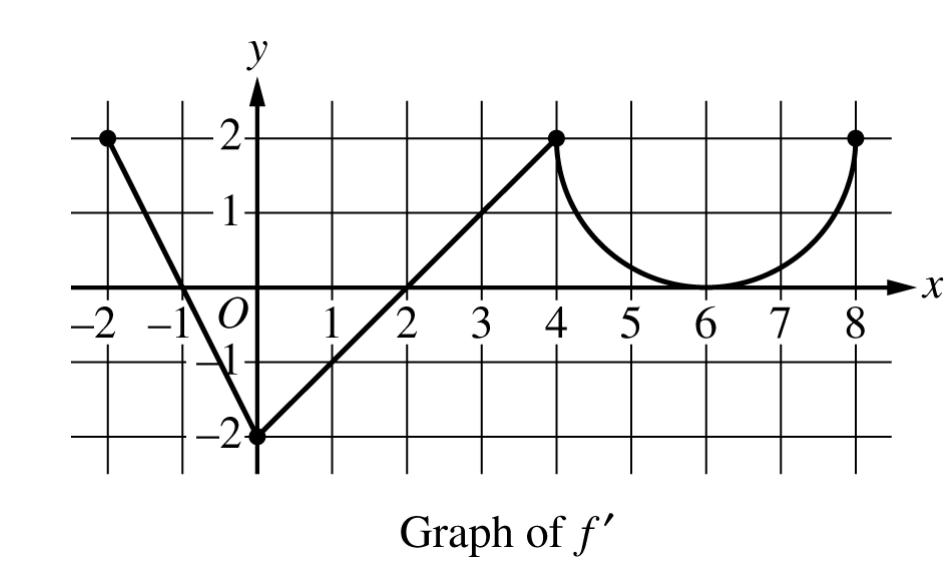
The function is defined on the closed interval and satisfies . The graph of , the derivative of , consists of two line segments and a semicircle, as shown in the figure: a line segment from down to , a line segment from up to , and a lower semicircle from down and back up to (dipping to a minimum of at ).
Part AMedium1 point
Does have a relative minimum, a relative maximum, or neither at ? Give a reason for your answer.
Answer
Neither — does not change sign at .
Full Solution & Work
Check the sign of f' around x = 6
on and on (the semicircle dips to touch 0 at but never goes negative).
Conclude
does not change sign at , so there is **neither** a relative maximum nor a relative minimum there.
AP Scoring — 1 Point
**P1**: Declaring does not change sign at , so neither, is sufficient — a response is not required to give specific sign intervals, but any given must be correct. Declaring before **and** after does not, by itself, earn this point without the "does not change sign" conclusion.
Part BMedium2 points
On what open intervals, if any, is the graph of concave down? Give a reason for your answer.
Answer
and
Full Solution & Work
Relate concavity of f to the behavior of f'
is concave down where is **decreasing**.
Read decreasing intervals off the graph of f'
decreases on (the first line segment, negative slope) and on (the left half of the semicircle, coming down from 2 to 0). So the graph of is concave down on ** and **.
AP Scoring — 2 Points
**P1**: Earned only for the answer and (endpoints may or may not be included).
**P2**: Requires P1. Must correctly discuss the behavior of (or the slopes of ) as the reason.
**P2**: Requires P1. Must correctly discuss the behavior of (or the slopes of ) as the reason.
Common mistake: A response with exactly one of the two correct intervals, with a correct reason, still earns 1 of the 2 points as a special case.
Part CHard3 points
Find the value of , or show that it does not exist. Justify your answer.
Answer
Full Solution & Work
Confirm the indeterminate form
Because is differentiable at , is continuous there, so .
The limit is of indeterminate form , so L'Hôpital's Rule can be applied.
The limit is of indeterminate form , so L'Hôpital's Rule can be applied.
Apply L'Hôpital's Rule
Read f'(2) off the graph and finish
From the graph, (the middle line segment crosses the -axis at ).
AP Scoring — 3 Points
**P1**: Presenting the two separate limits for the numerator and denominator (a response that presents a limit explicitly equal to does not earn this point).
**P2**: Applying L'Hôpital's Rule — presenting at least one correct derivative in the limit of a ratio of derivatives.
**P3**: The correct answer, 3, with supporting work.
**P2**: Applying L'Hôpital's Rule — presenting at least one correct derivative in the limit of a ratio of derivatives.
**P3**: The correct answer, 3, with supporting work.
Part DHard3 points
Find the absolute minimum value of on the closed interval . Justify your answer.
Answer
Full Solution & Work
Find critical points
Evaluate f at critical points and endpoints
is continuous on , so the candidates for the absolute minimum are .
(these are found by adding/subtracting the signed areas between consecutive -values, using as the anchor value)
(these are found by adding/subtracting the signed areas between consecutive -values, using as the anchor value)
Conclude
The smallest value in the table is . The absolute minimum value of on is .
AP Scoring — 3 Points
**P1**: Stating (or equivalent) — merely listing the zeros of is not sufficient.
**P2**: A justification: is continuous on and correctly evaluated at all 5 candidates. Any error in evaluating at a candidate point forfeits this point. (A response need not evaluate if it argues is a local max via other reasoning, and need not evaluate if it argues for , hence .)
**P3**: Earned only for indicating the minimum value is 1 — noting only that the minimum *occurs at* is not sufficient.
**P2**: A justification: is continuous on and correctly evaluated at all 5 candidates. Any error in evaluating at a candidate point forfeits this point. (A response need not evaluate if it argues is a local max via other reasoning, and need not evaluate if it argues for , hence .)
**P3**: Earned only for indicating the minimum value is 1 — noting only that the minimum *occurs at* is not sufficient.
Study the concept
Learn the theory behind this question type with worked examples and strategy tips.

Gary Chang
Calculus Educator5+ Years of Calculus Teaching Experience | AP Calculus Specialist. Dedicated to helping students master calculus through step-by-step logic and clear visualizations.
Finished reviewing?
Keep your momentum going
Practice multiple choice80 AP-style MCQs with full explanations, or a timed 45-question exam.Estimate your AP scorePlug in your MCQ and FRQ points to see your likely 1–5.Follow the 30-day planA day-by-day review of every AP Calc AB unit, from limits to volume.Practice FRQ by topicMaster each question type before the next exam.