2024 AP Calculus AB FRQ Question 4: Region R and Its Accumulation Function
Full worked solution for every part, with AP scoring notes. See all 6 questions from 2024.
Question 4
No CalculatorRegion R and Its Accumulation Function
Graph Analysis & Curve Sketching
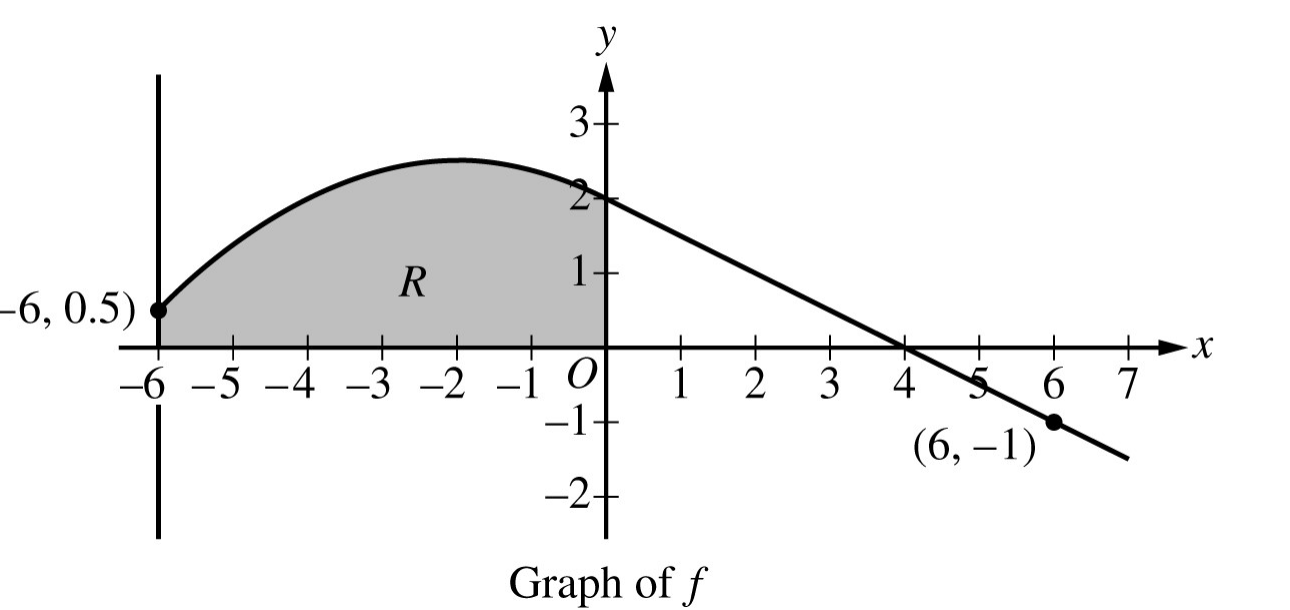
The graph of the differentiable function , shown for , has a horizontal tangent at and is linear for . Let be the region in the second quadrant bounded by the graph of , the vertical line , and the - and -axes. Region has area 12.
Part AMedium3 points
The function is defined by . Find the values of , , and .
Answer
, ,
Full Solution & Work
Find g(-6) using region R's given area
(since is exactly the area of , given as 12)
Find g(4) as a triangle area
is linear on , passing through and ... reading the graph, the line from crosses the -axis at :
Find g(6) as a signed sum of triangle areas
AP Scoring — 3 Points
**P1**: .
**P2**: .
**P3**: .
Supporting work is not required for any of these, but any shown work must be correct to earn the point. Unlabeled values are read left-to-right / top-to-bottom as — a response presenting only 1 or 2 values must label them to earn credit.
**P2**: .
**P3**: .
Supporting work is not required for any of these, but any shown work must be correct to earn the point. Unlabeled values are read left-to-right / top-to-bottom as — a response presenting only 1 or 2 values must label them to earn credit.
Part BMedium2 points
For the function defined in part (a), find all values of in the interval at which the graph of has a critical point. Give a reason for your answer.
Answer
Full Solution & Work
Apply the Fundamental Theorem of Calculus
Solve g'(x) = 0
Therefore, the graph of has a critical point at .
AP Scoring — 2 Points
**P1**: Explicitly making the connection in this part.
**P2**: Correct answer with reason — a response reporting any additional critical points in does not earn this point.
**P2**: Correct answer with reason — a response reporting any additional critical points in does not earn this point.
Part CHard4 points
The function is defined by . Find the values of , , and . Show the work that leads to your answers.
Answer
, ,
Full Solution & Work
Find h(6) using the Fundamental Theorem of Calculus
Find h'(6)
(the slope of the linear piece of on , found from the two labeled points -consistent slope )
Find h''(6)
(since is linear on , its second derivative is identically 0 there)
AP Scoring — 4 Points
**P1**: Uses the Fundamental Theorem of Calculus for .
**P2**: with supporting work — a bare answer of does not earn either of the first two points; earns only the first.
**P3**: States either or , and provides the answer .
**P4**: , with or without supporting work.
**P2**: with supporting work — a bare answer of does not earn either of the first two points; earns only the first.
**P3**: States either or , and provides the answer .
**P4**: , with or without supporting work.
Common mistake: Any response that has one or more linkage errors does not earn the point it would have otherwise earned for that step, but stays eligible for subsequent points if those are handled correctly.
Study the concept
Learn the theory behind this question type with worked examples and strategy tips.

Gary Chang
Calculus Educator5+ Years of Calculus Teaching Experience | AP Calculus Specialist. Dedicated to helping students master calculus through step-by-step logic and clear visualizations.
Finished reviewing?
Keep your momentum going
Practice multiple choice80 AP-style MCQs with full explanations, or a timed 45-question exam.Estimate your AP scorePlug in your MCQ and FRQ points to see your likely 1–5.Follow the 30-day planA day-by-day review of every AP Calc AB unit, from limits to volume.Practice FRQ by topicMaster each question type before the next exam.