2024 AP Calculus AB FRQ Question 6: Area and Volume Between f and g
Full worked solution for every part, with AP scoring notes. See all 6 questions from 2024.
Question 6
No CalculatorArea and Volume Between f and g
Area & Volume
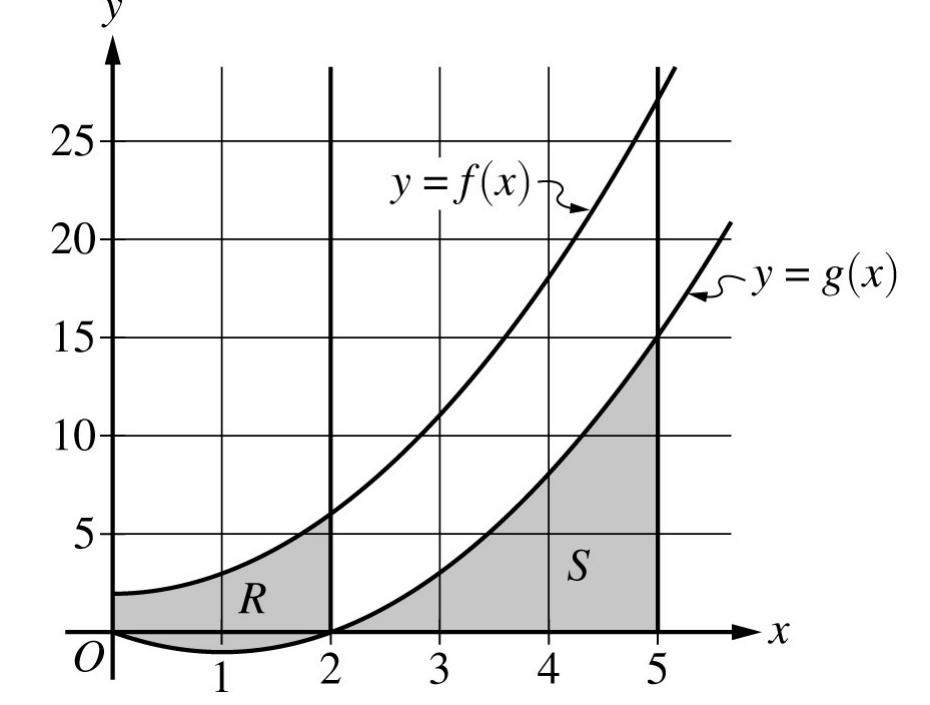
The functions and are defined by and , as shown in the graph.
Part AMedium2 points
Let be the region bounded by the graphs of and , from to , as shown in the graph. Write, but do not evaluate, an integral expression that gives the area of region .
Answer
Full Solution & Work
Set up the integrand
Since on (the two parabolas differ by , positive for ):
Write the area integral
AP Scoring — 2 Points
**P1**: An integrand of , , , or in one or more definite integrals (or, equivalently, a difference of definite integrals with integrands and ).
**P2**: Earned only for one or more integrals equivalent to .
**P2**: Earned only for one or more integrals equivalent to .
Part BHard4 points
Let be the region bounded by the graph of and the -axis, from to , as shown in the graph. Region is the base of a solid. For this solid, at each the cross section perpendicular to the -axis is a rectangle with height equal to half its base in region . Find the volume of the solid. Show the work that leads to your answer.
Answer
Full Solution & Work
Set up the volume integral
Expand and integrate
Evaluate the antiderivative at the bounds
AP Scoring — 4 Points
**P1**: An integrand of the form in a definite integral, for any nonzero constant .
**P2**: Limits of and in a definite integral with integrand for any nonzero factor .
**P3**: A correct antiderivative of for some integer .
**P4**: Earned only for the numeric answer (equivalent to ).
**P2**: Limits of and in a definite integral with integrand for any nonzero factor .
**P3**: A correct antiderivative of for some integer .
**P4**: Earned only for the numeric answer (equivalent to ).
Common mistake: A response that instead uses $f(x)$ in place of $g(x)$ throughout the setup (Volume $=\int_2^5 \frac12(f(x))^2 dx$) can still earn P1 and P2, but is not eligible for P3 or P4 — the cross sections are explicitly built on region $S$, which is bounded by $g$, not $f$.
Part CHard3 points
Write, but do not evaluate, an integral expression that gives the volume of the solid generated when region , as described in part (b), is rotated about the horizontal line .
Answer
Full Solution & Work
Identify outer and inner radii
Rotating about : the outer radius (to the -axis, the far boundary of ) is ; the inner radius (to , the near boundary) is .
Apply the washer method
AP Scoring — 3 Points
**P1**: An integrand of (or an equivalent expression, in any order/sign combination) in one or more definite integrals.
**P2**: Earned only for an integrand mathematically equivalent to — a response using in place of can still earn P1 but not P2.
**P3**: Earned only for a definite integral including the constant and limits to (limits reversed to to also work, provided the sign is adjusted accordingly).
**P2**: Earned only for an integrand mathematically equivalent to — a response using in place of can still earn P1 but not P2.
**P3**: Earned only for a definite integral including the constant and limits to (limits reversed to to also work, provided the sign is adjusted accordingly).
Study the concept
Learn the theory behind this question type with worked examples and strategy tips.

Gary Chang
Calculus Educator5+ Years of Calculus Teaching Experience | AP Calculus Specialist. Dedicated to helping students master calculus through step-by-step logic and clear visualizations.
Finished reviewing?
Keep your momentum going
Practice multiple choice80 AP-style MCQs with full explanations, or a timed 45-question exam.Estimate your AP scorePlug in your MCQ and FRQ points to see your likely 1–5.Follow the 30-day planA day-by-day review of every AP Calc AB unit, from limits to volume.Practice FRQ by topicMaster each question type before the next exam.