2025 AP Calculus AB FRQ Question 4: Accumulation Function from a Graph
Full worked solution for every part, with AP scoring notes. See all 6 questions from 2025.
Question 4
No CalculatorAccumulation Function from a Graph
Graph Analysis & Curve Sketching
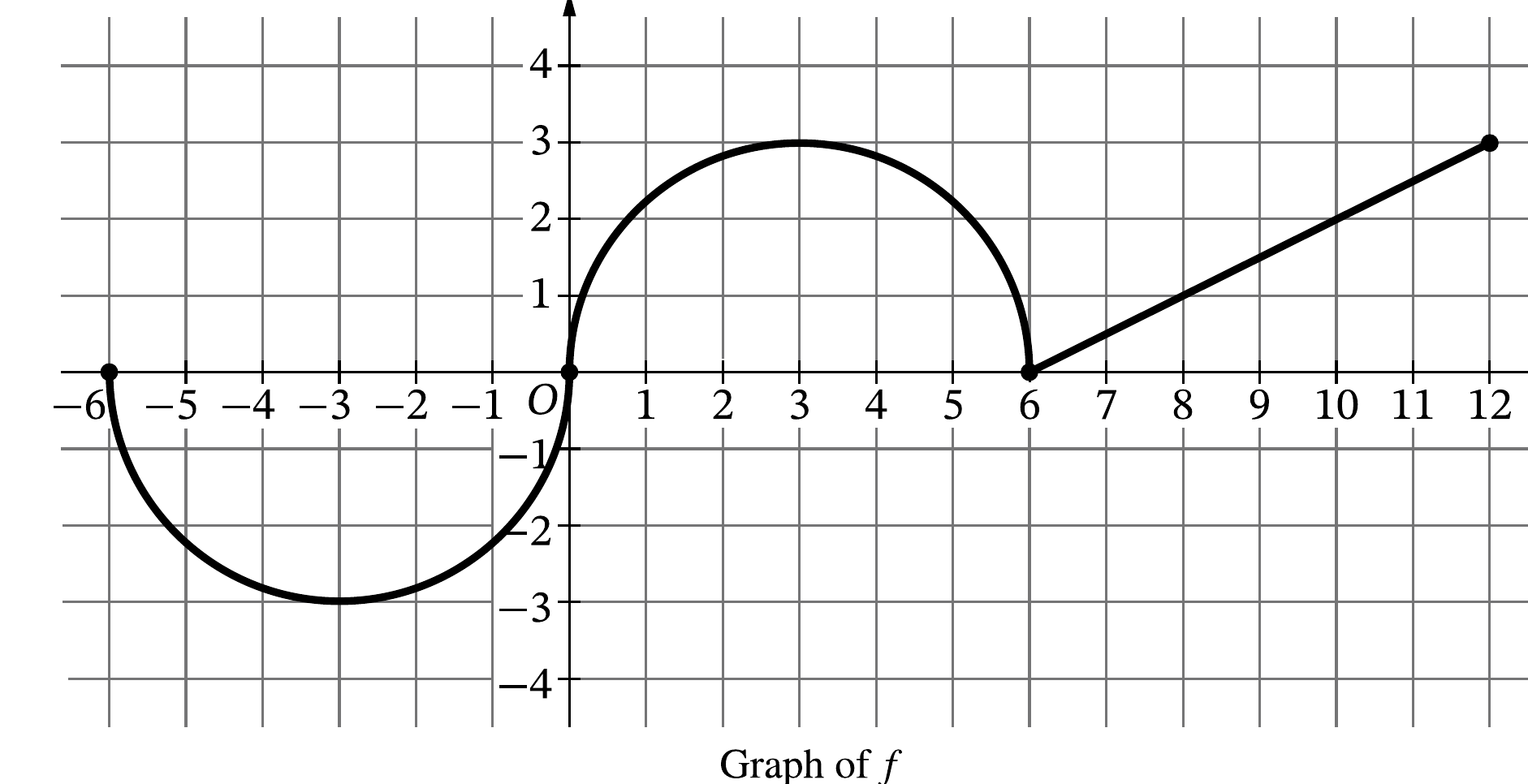
The continuous function is defined on the closed interval . The graph of , consisting of two semicircles (radius 3) and one line segment, is shown in the figure: a lower semicircle from down to and back up to , an upper semicircle from up to and back down to , and a line segment from to . Let be the function defined by .
Part AEasy2 points
Find . Give a reason for your answer.
Answer
Full Solution & Work
Apply the Fundamental Theorem of Calculus
Since , by FTC Part 1: .
Evaluate f(8) from the line segment
For , is the line through and , i.e. .
AP Scoring — 2 Points
**P1**: Considers .
**P2**: Correct answer . (An implied use of FTC, like writing directly by reading the graph, can also earn P2 without P1.)
**P2**: Correct answer . (An implied use of FTC, like writing directly by reading the graph, can also earn P2 without P1.)
Part BHard2 points
Find all values of in the open interval at which the graph of has a point of inflection. Give a reason for your answer.
Answer
, , and — the graph of has points of inflection at all three.
Full Solution & Work
Relate inflection points of g to f
, so has an inflection point wherever changes sign — equivalently, wherever changes from decreasing to increasing or increasing to decreasing (a local extremum of ).
Read local extrema off the graph of f
At : decreases (left semicircle going down) then increases (coming back up) — a local minimum of .
At : increases (right semicircle going up) then decreases (coming back down) — a local maximum of .
At : is still decreasing just before (end of the upper semicircle) and increasing just after (start of the line segment) — another local minimum of , even though the graph has a corner there.
At : increases (right semicircle going up) then decreases (coming back down) — a local maximum of .
At : is still decreasing just before (end of the upper semicircle) and increasing just after (start of the line segment) — another local minimum of , even though the graph has a corner there.
Conclusion
changes from decreasing to increasing at and , and from increasing to decreasing at . So the graph of has points of inflection at , , and .
AP Scoring — 2 Points
**P3**: Correct answer — earned *only* for exactly . Naming any additional or different value forfeits both points.
**P4**: A reason tied to the given graph of (e.g. " changes from increasing to decreasing / decreasing to increasing there", or " has a local extremum there"). A reason based on an ambiguous "the function" or "the graph," without specifying , does not earn P4.
**P4**: A reason tied to the given graph of (e.g. " changes from increasing to decreasing / decreasing to increasing there", or " has a local extremum there"). A reason based on an ambiguous "the function" or "the graph," without specifying , does not earn P4.
Common mistake: The corner at $x=6$ is easy to miss — students often only report $x=-3$ and $x=3$ since those look like the "obvious" smooth extrema, but $f$ still switches from decreasing to increasing there, so $g$ still has an inflection point.
Part CMedium2 points
Find and . Label your answers.
Answer
and
Full Solution & Work
Compute g(12) as a signed area
(area of the triangle under the line segment from to )
Compute g(0) as a signed area
(the upper semicircle from to has area ; the direction of integration flips the sign)
AP Scoring — 2 Points
**P5**: , with or without supporting work.
**P6**: , with or without supporting work. Both values must be clearly labeled — unlabeled numbers do not earn credit.
**P6**: , with or without supporting work. Both values must be clearly labeled — unlabeled numbers do not earn credit.
Part DHard3 points
Find the value of at which attains an absolute minimum on the closed interval . Justify your answer.
Answer
Full Solution & Work
Find critical points of g
attains an absolute minimum either at a critical point () or an endpoint. From the graph, at and .
Evaluate g at all candidates
(using , and the values of , from part C)
Conclusion
The smallest value in the table is at , so attains its absolute minimum on at .
AP Scoring — 3 Points
**P7**: Considers or (not earned by simply stating with no equation).
**P8**: A complete justification — a candidates-test table evaluating at , , , (values may be imported from part C), or an equivalent global sign argument.
**P9**: Correct answer .
**P8**: A complete justification — a candidates-test table evaluating at , , , (values may be imported from part C), or an equivalent global sign argument.
**P9**: Correct answer .
Study the concept
Learn the theory behind this question type with worked examples and strategy tips.

Gary Chang
Calculus Educator5+ Years of Calculus Teaching Experience | AP Calculus Specialist. Dedicated to helping students master calculus through step-by-step logic and clear visualizations.
Finished reviewing?
Keep your momentum going
Practice multiple choice80 AP-style MCQs with full explanations, or a timed 45-question exam.Estimate your AP scorePlug in your MCQ and FRQ points to see your likely 1–5.Follow the 30-day planA day-by-day review of every AP Calc AB unit, from limits to volume.Practice FRQ by topicMaster each question type before the next exam.