2026 AP Calculus AB FRQ Question 5: Remote-Controlled Car Motion
Full worked solution for every part, with AP scoring notes. See all 6 questions from 2026.
Question 5
No CalculatorRemote-Controlled Car Motion
Particle Motion
A remote-controlled toy car moves back and forth along a straight path so that its velocity at time is given by the function , where is measured in feet per second and is measured in seconds. where is in ft/sec and in seconds.
The graph of is shown.
The graph of is shown.
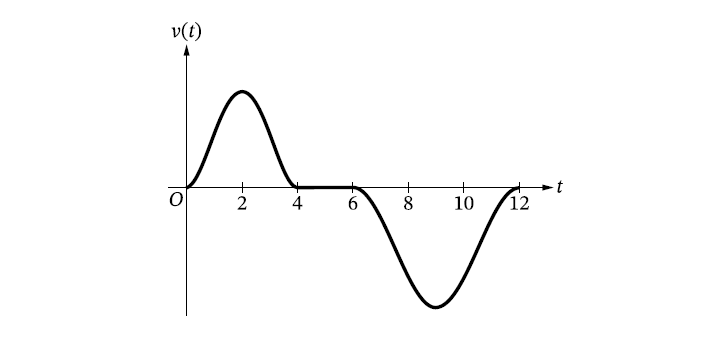
Part AEasy2 points
Find the acceleration of the car at time second. Show the work that leads to your answer.
Answer
ft/sec²
Full Solution & Work
Differentiate v(t) on [0, 4]
For :
Evaluate at t = 1
AP Scoring — 2 Points
**P1**: Correct derivative .
**P2**: Correct answer ft/sec².
**P2**: Correct answer ft/sec².
Part BEasy1 point
Is the car speeding up or slowing down at time second? Give a reason for your answer.
Answer
The car is speeding up at because and (same sign).
Full Solution & Work
Find v(1)
Compare signs of v and a
Since and , velocity and acceleration have the **same sign**. The car is **speeding up**.
AP Scoring — 1 Point
**P1**: 'Speeding up' with justification that and have the same sign.
Part CMedium3 points
Find the distance, in feet, that the car traveled over seconds.Show the work that leads to your answer.
Answer
ft
Full Solution & Work
Check if v changes sign on [0, 4]
Factor: for all . So on — no sign change.
Set up and evaluate the integral
Simplify
Common denominator 15:
AP Scoring — 3 Points
**P1**: Recognizes distance = and justifies .
**P2**: Correct antiderivative.
**P3**: Correct answer ft.
**P2**: Correct antiderivative.
**P3**: Correct answer ft.
Part DMedium3 points
Find the average velocity of the car over the time interval seconds. Show the work that leads to your answer.
Answer
ft/sec
Full Solution & Work
Set up the average velocity formula
Find the antiderivative
Evaluate from 6 to 12
At : .
At : .
Compute average velocity
The negative sign indicates net motion in the negative direction.
AP Scoring — 3 Points
**P1**: Correct average velocity setup .
**P2**: Correct antiderivative.
**P3**: Correct answer ft/sec.
**P2**: Correct antiderivative.
**P3**: Correct answer ft/sec.
Study the concept
Learn the theory behind this question type with worked examples and strategy tips.

Gary Chang
Calculus Educator5+ Years of Calculus Teaching Experience | AP Calculus Specialist. Dedicated to helping students master calculus through step-by-step logic and clear visualizations.
Finished reviewing?
Keep your momentum going
Practice multiple choice80 AP-style MCQs with full explanations, or a timed 45-question exam.Estimate your AP scorePlug in your MCQ and FRQ points to see your likely 1–5.Follow the 30-day planA day-by-day review of every AP Calc AB unit, from limits to volume.Practice FRQ by topicMaster each question type before the next exam.