2026 AP Calculus AB FRQ Question 3: Cooling Pie — Differential Equations
Full worked solution for every part, with AP scoring notes. See all 6 questions from 2026.
Question 3
No CalculatorCooling Pie — Differential Equations
Differential Equations
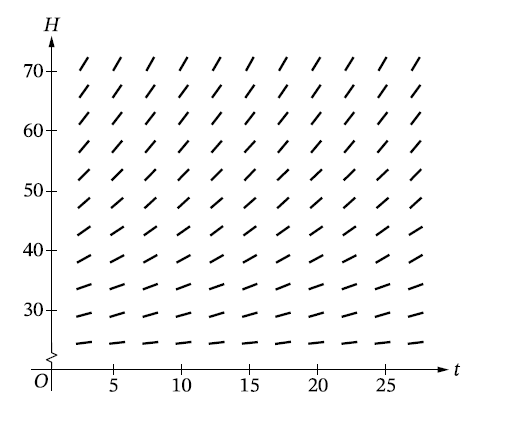
A pie is taken from a hot oven and put on a table. The internal temperature of the pie at time minutes can be modeled by the function that satisfies the differential equation , where is measured in degrees Celsius and . For , it is known that .
Part AMedium2 points
Explain why the following could not be a slope field for the differential equation .
Answer
The slope field shows positive slopes for , but the differential equation gives whenever . Therefore the slope field is incorrect.
Full Solution & Work
Analyze the sign of dH/dt
When : , so . Slopes must be **negative** for all .
Identify the contradiction
The shown slope field displays positive (upward) slopes for , which contradicts the differential equation. This is why the slope field could not be correct.
AP Scoring — 2 Points
**P1**: States when .
**P2**: Connects this to the slope field showing positive slopes, hence the contradiction.
**P2**: Connects this to the slope field showing positive slopes, hence the contradiction.
Part BEasy2 points
Find the slope of the line tangent to the graph of at time . Show the work that leads to your answer.
Answer
Full Solution & Work
Substitute H(0) = 75 into the differential equation
AP Scoring — 2 Points
**P1**: Substitutes correctly into the ODE.
**P2**: Correct slope (or equivalent decimal ).
**P2**: Correct slope (or equivalent decimal ).
Part CMedium2 points
It can be shown that . The line tangent to the graph of at time is used to approximate , the internal temperature of the pie at time . Is this approximation an overestimate or an underestimate for the actual value of ? Give a reason for your answer.
Answer
Underestimate. Since for , the graph of is concave up, so the tangent line lies below the curve.
Full Solution & Work
Determine the sign of the second derivative
For : , so . The graph of is **concave up**.
Conclude overestimate or underestimate
When a function is concave up, the tangent line lies **below** the curve. Therefore the tangent line approximation of is an **underestimate**.
AP Scoring — 2 Points
**P1**: Identifies (concave up).
**P2**: States 'underestimate' with concavity reasoning.
**P2**: States 'underestimate' with concavity reasoning.
Part DHard6 points
Use separation of variables to find an expression for , the particular solution to the given differential equation with initial condition .
Answer
Full Solution & Work
Separate variables
Integrate both sides
Exponentiate and solve for H
Apply the initial condition H(0) = 75
Write the particular solution
Verification: as , ✓ (the pie cools to room temperature).
AP Scoring — 6 Points
**P1**: Correct separation of variables.
**P2**: Correct antiderivatives on both sides.
**P3**: on left side.
**P4**: Correct general solution form .
**P5**: Uses to find .
**P6**: Correct particular solution .
**P2**: Correct antiderivatives on both sides.
**P3**: on left side.
**P4**: Correct general solution form .
**P5**: Uses to find .
**P6**: Correct particular solution .
Common mistake: Forgetting the absolute value in $\ln|H-20|$ or dropping the constant of integration are the two most common errors. Both cost points.
Study the concept
Learn the theory behind this question type with worked examples and strategy tips.

Gary Chang
Calculus Educator5+ Years of Calculus Teaching Experience | AP Calculus Specialist. Dedicated to helping students master calculus through step-by-step logic and clear visualizations.
Finished reviewing?
Keep your momentum going
Practice multiple choice80 AP-style MCQs with full explanations, or a timed 45-question exam.Estimate your AP scorePlug in your MCQ and FRQ points to see your likely 1–5.Follow the 30-day planA day-by-day review of every AP Calc AB unit, from limits to volume.Practice FRQ by topicMaster each question type before the next exam.