2026 AP Calculus AB FRQ Question 2: Area and Volume Between Curves
Full worked solution for every part, with AP scoring notes. See all 6 questions from 2026.
Question 2
Calculator OKArea and Volume Between Curves
Area & Volume
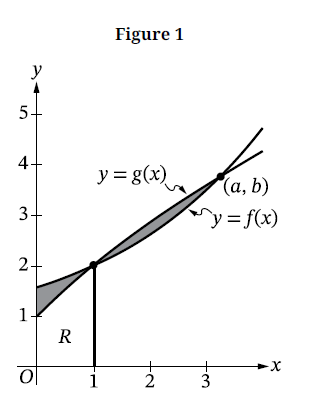
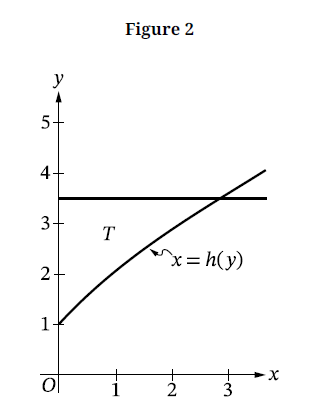
The function is defined by , and the function is defined by . The graphs of and intersect at the points and as shown in Figure 1. For , the equation can be rewritten as , where is a function of .The graph of and the horizontal line are shown in Figure 2.
Part AMedium3 points
Let be the region bounded by the graph of , the -axis, the -axis, and the vertical line as shown in Figure 1. Find the area of region . Show the setup for your calculations.
Answer
Full Solution & Work
Set up the integral
The area of region is found by integrating the function from to :
Analytical verification
To evaluate the integral manually:
- **Step 1: Simplify the integrand**
- **Step 2: Integrate**
- **Step 3: Evaluate from 0 to 1**
- **Step 1: Simplify the integrand**
- **Step 2: Integrate**
- **Step 3: Evaluate from 0 to 1**
AP Scoring — 3 Points
• **1 pt**: Correct integral setup .
• **1 pt**: Correct antiderivative or appropriate use of calculator.
• **1 pt**: Final answer accurate to three decimal places (1.513).
• **1 pt**: Correct antiderivative or appropriate use of calculator.
• **1 pt**: Final answer accurate to three decimal places (1.513).
Part BMedium2 points
Region ,described in part A is the base of a solid.For this solid,each cross section perpendicular to the -axis is a rectangle whose height is times the length of its base in region . Write, but do not evaluate, an integral expression that gives the volume of the solid.
Answer
Full Solution & Work
Set up cross-sectional area
At each , the base of the rectangle is (height of region ). The height of the rectangle is . So the cross-sectional area is:
Write the volume integral
AP Scoring — 2 Points
**P1**: Integrand with correct bounds .
**P2**: Correct integral expression (do not evaluate).
**P2**: Correct integral expression (do not evaluate).
Part CHard4 points
The shaded region in Figure 1 is bounded by the graphs of and on the interval from to . Find the area of the shaded region. Show the setup for your calculations.
Answer
Full Solution & Work
Find the second intersection point a
The graphs of and intersect when . Given and , use a graphing calculator to solve for the second intersection point in the first quadrant:
Set up the integral
The shaded region consists of two parts because the graphs cross at . The total area is the integral of the absolute difference between the functions from to :
Evaluate using the calculator
To calculate precisely, split the integral at the intersection point :
AP Scoring — 4 Points
• **1 pt**: Correct value for (3.256).
• **1 pt**: Correct integral setup with absolute value or split at .
• **1 pt**: Correct identification of upper/lower functions in each interval.
• **1 pt**: Final numerical answer (0.632).
• **1 pt**: Correct integral setup with absolute value or split at .
• **1 pt**: Correct identification of upper/lower functions in each interval.
• **1 pt**: Final numerical answer (0.632).
Part DHard3 points
Let be the region bounded by the graph of , the -axis, and the horizontal line as shown in Figure 2. Write, but do not evaluate, an integral expression for the volume of the solid when is revolved about the -axis.
Answer
Full Solution & Work
Identify the bounds in y
Region is bounded below by (since , the curve starts at the -axis when ) and above by .
Apply the disk method about the y-axis
Revolving about the -axis, each disk has radius :
AP Scoring — 3 Points
**P1**: Correct method (disk/washer about -axis).
**P2**: Correct integrand .
**P3**: Correct bounds to .
**P2**: Correct integrand .
**P3**: Correct bounds to .
Study the concept
Learn the theory behind this question type with worked examples and strategy tips.

Gary Chang
Calculus Educator5+ Years of Calculus Teaching Experience | AP Calculus Specialist. Dedicated to helping students master calculus through step-by-step logic and clear visualizations.
Finished reviewing?
Keep your momentum going
Practice multiple choice80 AP-style MCQs with full explanations, or a timed 45-question exam.Estimate your AP scorePlug in your MCQ and FRQ points to see your likely 1–5.Follow the 30-day planA day-by-day review of every AP Calc AB unit, from limits to volume.Practice FRQ by topicMaster each question type before the next exam.