2026 AP Calculus AB FRQ Question 4: Analyzing a Function from its Derivative Graph
Full worked solution for every part, with AP scoring notes. See all 6 questions from 2026.
Question 4
No CalculatorAnalyzing a Function from its Derivative Graph
Graph Analysis & Curve Sketching
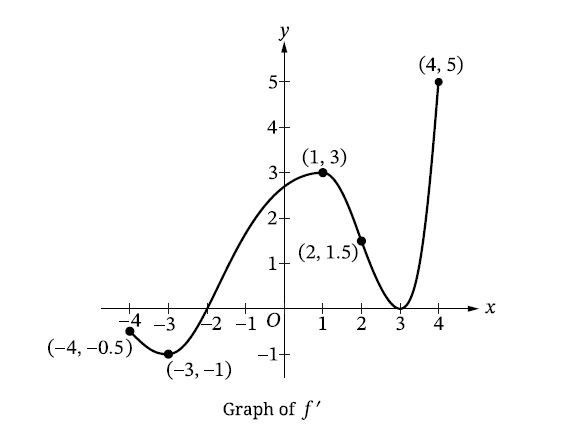
Let be a twice-differentiable function on with . The graph of , the derivative of , is shown, passing through the points , , , , and .
Part AEasy2 points
For , the function g is defined by . Find . Show the work that leads to your answer.
Answer
Full Solution & Work
Differentiate g(x)
Evaluate at x = 2
From the graph of : .
AP Scoring — 2 Points
**P1**: (correct differentiation).
**P2**: Correct answer .
**P2**: Correct answer .
Part BMedium2 points
Find all values of on the open interval at which the graph of has a point of inflection. Give a reason for your answer.
Answer
has a point of inflection at because changes sign there (from positive to negative on the graph of ).
Full Solution & Work
Recall: inflection points occur where f'' changes sign
Since , inflection points of occur where changes from increasing to decreasing (or vice versa), i.e., where has a local extremum.
Read the graph of f'
On : increases then decreases, with a local maximum at . At , changes from increasing to decreasing, so changes from to .
Conclusion
There is exactly one point of inflection: . At , changes sign from positive to negative.
AP Scoring — 2 Points
**P1**: Identifies .
**P2**: Justification — changes from increasing to decreasing at , so changes sign.
**P2**: Justification — changes from increasing to decreasing at , so changes sign.
Part CMedium2 points
On , on what open intervals, if any, is the graph of both increasing and concave down? Give a reason for your answer.
Answer
is both increasing and concave down on the interval .
Full Solution & Work
Condition 1: Increasing ($f'(x) > 0$)
The graph of increases when its derivative is positive. Based on the provided graph, on the intervals and .
Condition 2: Concave Down ($f''(x) < 0$)
The graph of is concave down when , which corresponds to where is decreasing. From the graph, decreases on the intervals and .
Intersection of Conditions
To satisfy both conditions, we find the intersection of and . The only interval that satisfies both is .
AP Scoring — 2 Points
P1: Correct interval .
P2: Reason — States that is increasing because and concave down because is decreasing on this interval.
P2: Reason — States that is increasing because and concave down because is decreasing on this interval.
Part DHard4 points
On , find the value of at which has an absolute minimum and the value of at which has an absolute maximum. Give reasons for your answers.
Answer
Absolute minimum at ; absolute maximum at .
Full Solution & Work
Identify Candidate Points
Absolute extrema can only occur at endpoints or critical points where . From the graph, at and .
Analyze the Absolute Minimum
On the interval , , so is decreasing. On , (except at where it is 0), so is increasing. Since the function decreases from to and increases from to , the absolute minimum must occur at .
Analyze the Absolute Maximum
Since is increasing on the entire interval , we only need to compare the endpoints and . Because the area under from to is much larger than the magnitude of the area from to , the absolute maximum occurs at the right endpoint .
AP Scoring — 4 Points
P1: Identifies and as critical points.
P2: Justifies absolute minimum at using the sign change of .
P3: Justifies absolute maximum at by noting increases on .
P4: Correct values for both.
P2: Justifies absolute minimum at using the sign change of .
P3: Justifies absolute maximum at by noting increases on .
P4: Correct values for both.
Study the concept
Learn the theory behind this question type with worked examples and strategy tips.

Gary Chang
Calculus Educator5+ Years of Calculus Teaching Experience | AP Calculus Specialist. Dedicated to helping students master calculus through step-by-step logic and clear visualizations.
Finished reviewing?
Keep your momentum going
Practice multiple choice80 AP-style MCQs with full explanations, or a timed 45-question exam.Estimate your AP scorePlug in your MCQ and FRQ points to see your likely 1–5.Follow the 30-day planA day-by-day review of every AP Calc AB unit, from limits to volume.Practice FRQ by topicMaster each question type before the next exam.